This
is one camera which web pictures don't do justice. In fact this was
the first time for ages when I was taken in by the packaging. From
the online material I was expecting something pretty big but the box
was tiny... and heavy. The D10 feels smaller than it looks too, as
soon as you pick it up the bulbous curves fit into your hands the way
a cuboid just can't. A very tactile device... it's easy to get
carried away.
The
D10 is Canon's first waterproof digital camera, way back in the last
century they had a popular range of APC snorkelling models but its
been a long dry spell. They haven't toyed with more conservatively
rated models, the D10 is rated to a market leading 10m (i.e. Olympus
matching). It sits at the top of a range of one! Price and size wise
it's top of the market too. The choice of name is odd, fitting into
the scheme Canon uses for its SLRs but to be fair there's absolutely
no chance of confusion in the flesh.
Shaping
up
Appearance
and physical appeal dominate a first encounter with the D10. There's
plenty of shiny bits, exposed stainless fasteners and all those
curves to play in the light as you handle it. That obscures the
thickness of the two waterproof hatches – one for power and USB
connection the other for battery and SD card. It also takes a while
to realise that while there is metal, the vast majority of the body
is painted plastic, so the beautiful finish may suffer from bumps and
scrapes. The camera is impressively heavy, the internal frame is
clearly metal allowing the most extrovert flourish on the D10, a big
lanyard fixing point at each corner. These are real statement pieces
of machining which allow the camera to be attached by an amazing
cast, locking 'nipple' in three ways more than necessary. The D10 is
trying hard to justify its premium over all its competitors. You can
also see that the tripod mount screws straight into the internal
metal frame. |
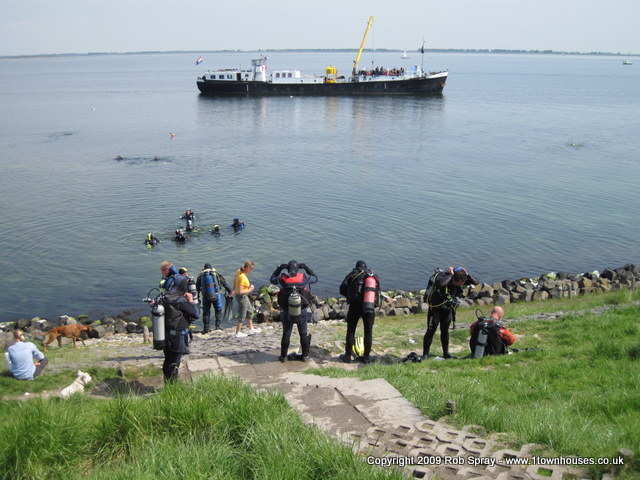
Our annual Dutch trip is an ideal test, most of the dives are shallow
|
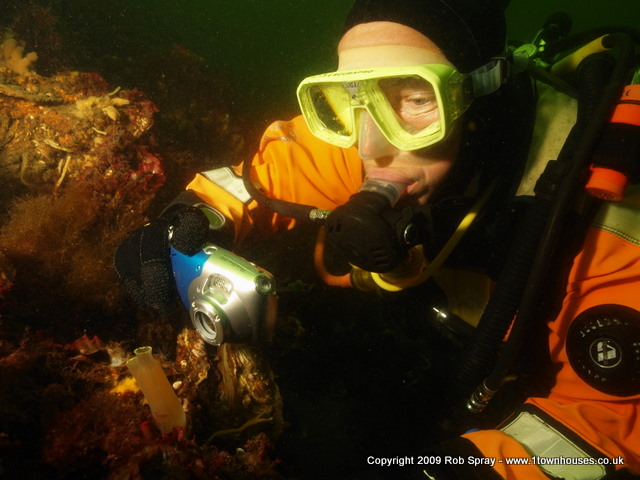
Dawn really took to the D10, though it's tricky to use in gloves | The
10m rating puts it head to head with Olympus top Tough model, the
8000, which is the only other current camera with this depth rating.
Olympus have quite a track record here with the 8000 being their
third at 10m and a fleet of 3m models. It seems quite clear that
Canon have taken note of this experience and the D10 seals look very
impressive, and are actually effective beyond what is probably quite
a conservative rating. The waterproofing of the D10 takes a slightly
different tack from the Olympus. Both have two hatches and on both
the smaller one is just a lipped gasket but the larger one is fitted
with a real dive housing style 'o'ring where Olympus stick with a
larger lipped rubber gasket. Both seem to work fine and by
coincidence we can confirm that both are perfectly effective to
double their rated depth. The 'o' ring will be more fiddly to clean
and should be lightly greased, which makes debris stick to it...
which means it needs more cleaning. The Canon worked fine at the
'test' depth and is calmer about the experience since it doesn't have
the Mju's depth gauge to warn you. |
|
Glassware
The
use of a conventional lens has both strengths and weaknesses. Folded
systems weren't as good but they have improved hugely. So the Canon
lens is brighter, at f2.8, than any competitor but has more limited
range and less effective macro. Close up the protruding lens can cast
shadows on small subjects, flat cameras don't suffer this indignity.
The risk of this vignetting is increased by a stout aluminium ring
which secures the front glass but could so easily have been threaded
for filters and extra lenses. In favour of this system there is no
delay on start up, the Olympi have a metal shutter to move out the
way. The two companies have also taken a different track with the
basis of their designs with the D10 quite conventional within its
Faberge egg casing and the Olympus using folded optics, lots more
exterior metal and more of a Rolex motif. The Olympus 8000 Tough is
more grown up and perhaps better able to mix formal events with rough
and tumble.
| 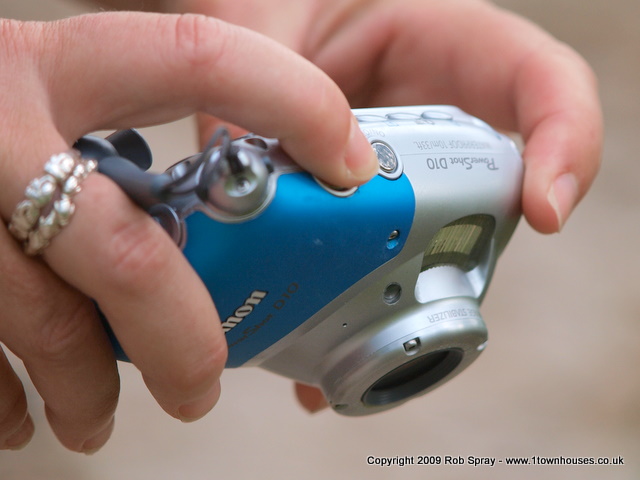
The protruding lens masks the flash very close up
|
As
the outer case must rigidly cover the lens in all positions it cannot
retract so the D10 isn't a true pocket camera, unless you want to
enjoy some Carry On humour of course :-) The 3x zoom starting at the
equivalent of 35mm is the least flexible lens in this part of the
market with many competitors starting at 28mm – which is very
useful underwater where all flat ports cause a 25% magnification.
The
control layout of the D10 will be familiar to anyone who has tried a
Canon Powershot, bar the use of buttons for zoom control and mode
switching - instead of hard to seal dials and sliders. Thus the
ergonomics are easy to figure out and the two button for the two
level – picture and system – menu is a treat after digging
through some others. |
Some of the reef residents are quite feisty
|
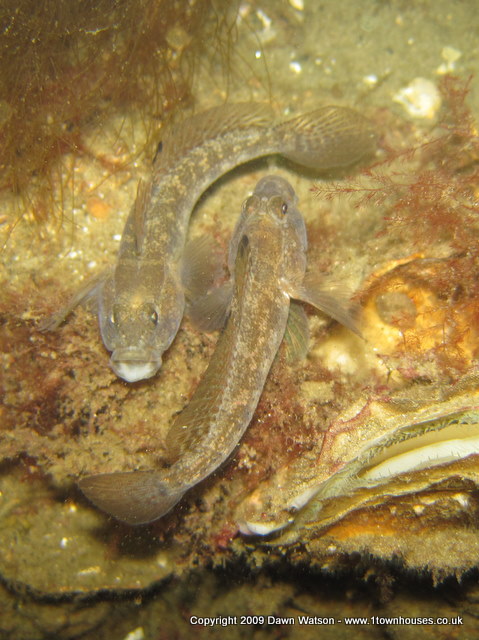
It was good going for a compact to catch these arguing fish | Putting
what seems to be a Powershot chassis into a case instantly benefits
from the development of that very successful line and the D10 is fast
and logical to use. Like the Olympi it assumes you will probably use
Auto or Program and keeps its welter of scene modes accessible but
compact. Shooting video is given top level status rather than
relegated to being one of the modes which is a good choice given the
likely use of the D10 on the beach for family holidays. Its a shame
that macro is always its second focus choice after landscape as I'm a
fiend for small stuff and I'm not sure I've ever been so surprised by
a mountain that I needed that option first under my trigger finger. |
Day
to day practicalities
Unlike
a lot of compacts these days the D10 has no internal memory available
for pictures, which is no real loss. Surprisingly there's no small
card in the box either, again not a big deal, though bear it in mind
if you plan to present one as a gift. It takes SD, the cheapest and
fastest of the mainstream cards, via adaptors that can include the
smaller versions of them too.
The
battery is smaller than one might expect given the outer dimensions
of the camera but the thick, well secured hatch and reinforced outer
skin dictate that, although it's of a slightly higher capacity than
its competitors. As we went on we had to keep lowering our
expectations on battery life, days underwater really do seem to drain
it when you use flash and have the screen on for long periods. In use
which included quite a lot of menu hopping and flash use we managed
140-160 shots per charge, not very impressive. Lifespan may be longer
in warmer climes where batteries work better but perhaps that bulbous
body does help to keep the internal workings insulated and the
battery doesn't have great capacity. As usual with a small camera a
spare battery is part of the kit you'll want for a day out.
|
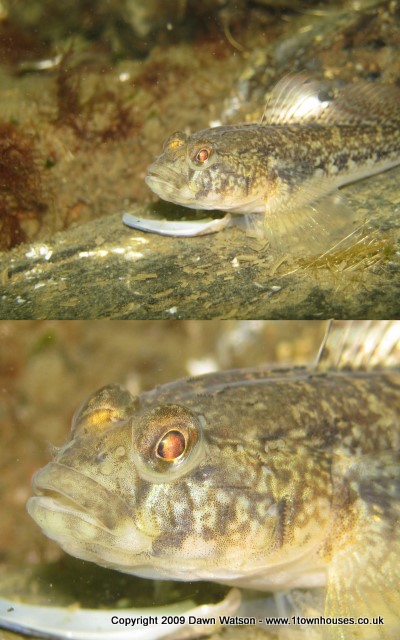
This crops shows the excellent low ISO detail
|
There's
no case or bag supplied, which is a shame as that groovy paint job
deserves protection. I assume other colours will become available as
the current splash of blue is a separate panel. Given the price a
neoprene slip case would have been a great addition to the package.
I'm sure they will be available and it would be a sensible way to
carry and coddle this toy so it's ready for use when you're out on
the water. Neoprene is eminently ideal as it will help the camera
float if it falls out of reach, it would sink on its own! Best keep
it tied on! The
emphasis of this review is in-water but remember that the toughening
process makes this, and cameras like it, great for the beach,
skiing, enduring the British summer and hot and humid foreign
climes. It is
rated proof against drops from 1.2m and -10oC
frost which makes it a good choice for any family day out. Children
will love its looks and you don't have to worry, too much, about them
hurting it. Underwater
In
the water it's very strange to handle a 'naked' camera, much easier
to see the control markings than one which is housed and much
smaller. With bare hands the cluster of small buttons isn't a problem
but in colder water any gloves make it hard to feel those which are
recessed beside the screen. The soap like shape is also predictably
slippery in gloved hands. Depending how you want to hold it the
lanyard 'nipple' can be moved to suit your grip but can't be said to
make a vast difference. The contours of the body make this a slightly
easier proposition to use than the flat Olympi but as with all
underwater gear bare hands work best! |
I'm
pleased to say our photo optimism was rewarded and the D10 returned
some good looking results from its first dive. The default underwater
setting allowed it to use a fast enough shutter and strong enough
flash so that the vivid underwater world of the Dutch oyster beds lit
up in all their surprising glory. What was more surprising was that
the D10 didn't struggle to focus in the cloudy, albeit bright shallow
waters. Deeper down it might hesitate but even at macro distances it
was quite straightforward to get sharp results. The one fly in the
ointment is that with the projecting lens surround and flash set well
back, subjects less than 15cm away are masked from the flash. However
as the working distance stays at 30cm throughout the zoom range (the
minimum 3cm minimum distance is available only at fully wide) it is
still practical to photograph quite small animals although focus is
more ponderous at telephoto. Flat, folded optic cameras avoid this
problem but even so it seems Canon could have reduced the problem and
may have chosen styling over practicality to place the flash so close
to the lens – which will also increase the risk of red eye.
|
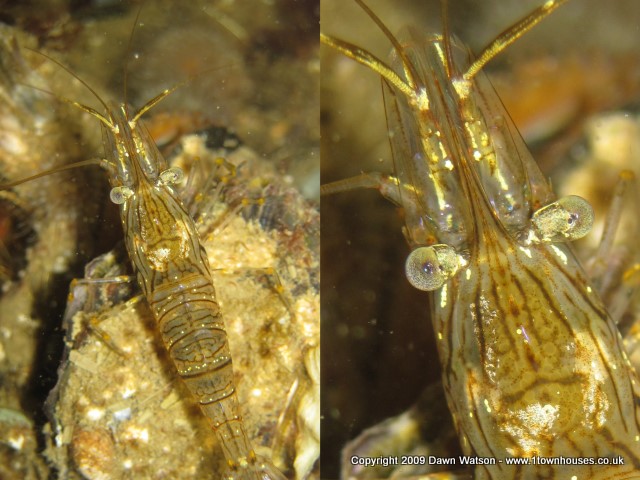
You can even see eggs inside this prawn
|
We
were very pleased with the crop of pictures we brought back and I
suspect for many people using exactly the same camera underwater,
with no housing to confuse the layout of buttons, might get them past
the mental block some have about submerged photography and ease them
into this hobby. The 10m depth limit is going to cramp your style for
a lot of diving but the top 10m can be very rewarding and this is
certainly a camera a tropical snorkeller could get great use out of.
With most dives going to 20m or more, a housed camera is the way to
take this hobby deeper but the D10 gives you a great, fun package and
a camera you can use on the shallower dives which are often the most
relaxed and rewarding. The screen itself is bright and contrasty
making use in the shallows quite practical and sharp enough that the
option to enlarge the screen centre as focus confirmation was
genuinely useful. Being able to set the camera to enlarge the centre
when focussed was clearer than a plain coloured square and also
confirmed (as far as a small LCD can) that it had done its job.
The
easy access to video shooting makes it very simple to capture clips
to show friends. The clips are fine but with a lot of cameras
offering HD capture its a shame that the D10 only offers VGA. Still
camera video is still a bit of a novelty feature but this is great
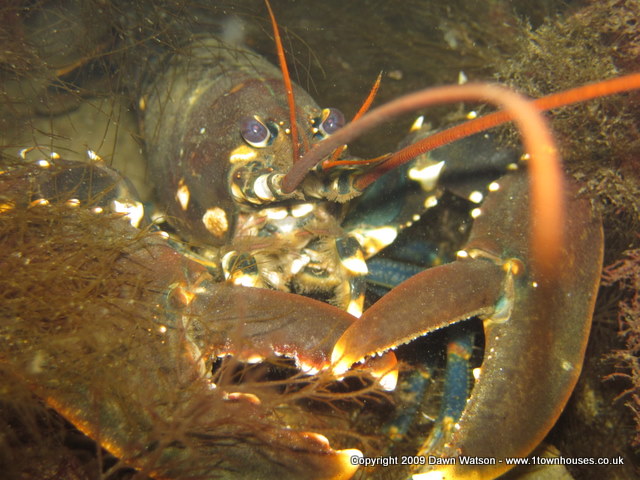
for uploading to YouTube to show the lobster that went for you! Each
1 minute of video takes the place of about 40 full size photos, so
even with just a 1 GB card you have room for about 12 minutes of
video (or 340 pictures). |

Note the highlights allowed to keep the picture bright | Technicalities
At
low ISO the pictures are very good but some noise reduction does
creep in fast as film speed increases. The image stabilisation does
mean that the D10 can hold low ISO longer and it controls what noise
there is well, though detail is reduced. Shots at ISO50-160 are
really very sharp, beyond ISO200 you won't enjoy all your 12
Megapixels as clever techniques are used to smother noise. This is
done well and for most uses the high ISO still turns out attractive
results. The modest lens works well and perhaps because it's a little
brighter, maybe because the camera is 3 years newer, it was faster to
focus in murky water than our equally watertight Mju770. On the
surface the D10 seemed slightly too liberal in handling highlights,
by which I mean it was quite willing to burnout even central detail
to keep the overall exposure on track. For the most part that
produced punchy vibrant pictures but occasionally bright faces would
get the treatment and spoil a picture. |
My
girlfriend, who abhors all things technical, found the menus easy to
master but was annoyed that after every power cycle the D10 had
dropped her settings for macro and zoom. Some people may want these
reset but it would be simple to offer the choice to hold these.
Another aspect which riled her was that the camera can be set to
power off after a period, to save power, but the longest it can be
set for is 3 minutes which is just a touch too short. 5 minutes would
seem a better compromise and still mind your battery after each
snatched shot of a gnarly tube run (or whatever young people do with
their time :-) This feature can be turned off but then you might risk
finding your camera flat just as you needed it. The
lanyard nipple system offers plenty of choice, which is marvellous of
course, but why make it like a bar of soap to start with? Maybe I'd
have been happier if there was a pair of them, not just for
anatomical symmetry and humour but then it could be slung round your
neck. A few bumps or some rubber on the right hand side would have
worked wonders and also protected the case. In common with an awful
lot of cameras it would also have been sensible to raise or dimple
the shutter button to make it easier to find with cold and/or gloved
hands.
|
Conclusion
It's
very, very easy to be taken in by the looks of the D10 and assume
it's just a good time Charlie, a toy. Underneath its sexy skin is a
nice, amenable camera of the kind you would have been very happy to
use a year or so ago before everything had to be complicated. That's
not to say it isn't capable, the 12 Megapixel sensor produces clean
sharp pictures on the surface and underwater which you could make
into posters and the user interface is the best kind of simple which
means you can take advantage of those moments you bought a waterproof
camera to capture.
Pros:
Great looks, good results straight away underwater, easy menu
ergonomics and flexible modes
Cons:
Protruding
lens bulky and masks macro flash, no case, easily scraped, extrovert
nipple! Below average battery life. Auto power off short.
Marks
out of ten -
Canon D10
Build quality 8/10
Fisher Price Frankenstein, in a good way!
Image quality 8/10 Excellent and attractive at low ISO
Handling
9/10 Easy menus
Overall mark
8.5/10 Fun for all the family |
---------------------------------------------------------
Vivid
Oceans and Secret Seas
www.1townhouses.co.uk |