Left
in the dark?
In
the constantly shifting camera market there's sometimes a dividend to
be gained from ploughing a different furrow. Most brands have tried
to establish a USP (unique selling point) to claim a niche for
themselves and for Fuji it is the dark. When low light performance
was the bane of digital photography they built a reputation for
clever solutions and held a brave resolve in sticking to larger,
lower resolution sensors rather than rushing into the unproductive
megapixel race a few years back. This served a well informed area of
the market with cameras which by all accounts gave great results but
lacked the finesse of competing products when it came to niceties
like user interfaces.
Now
the ex-champions of conservative pixel counts have decided that they
can offer it all and have built their new F200 around a new 'Super
CCD EXR' sensor which has 12 million pixels and still works in the
dark. They claim the sensor can offer high resolution, low noise and
capture highlights. Then they muddy this by saying that it can switch
between these three modes on the chip itself – thus implying that
the alleged holy trinity aren't really all available at the same
time. As a photographer I'm happy with good pictures so we'll have to
see whether the hype stacks up.
|
In
the hand
The
F200 has followed the F100 and appears to be its twin brother.
Outwardly very similar they differ in screen size – the F200 is .3”
larger at 3” and separates some controls onto an extra dial.
Otherwise you would be hard pushed to separate them in a line up as
those changes affect only the rear panel. The F200 is the kind of
solid, well built trinket which anyone would welcome. Apart from the
USB and battery doors the body is metal clad. Although the buttons
are plastic, there aren't many of them as the screen occupies most of
the back panel. It's not wafer thin but is easy to stow in a pocket
until the 3 section lens is powered up. I got to play with a black
F200 but plain polished stainless steel is available. The top and
bottom surfaces are slightly concave which is supposed to make it
easy to hold and certainly succeeds in adding a little style to the
oblong profile.
The
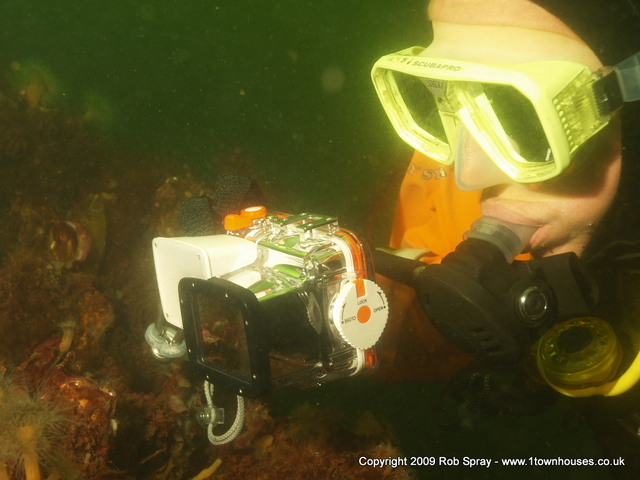
matching WP-FXF200 dive housing is equally pleasant to play with too.
Reassuringly rigid and devoid of vulnerable protrusions it should
survive life on board even UK dive boats and so should be easy to
keep safe in the tropics where things are more genteel. The most
notable feature of the case is the clever way it includes two 'o'
ring seals on the back door, a unique feature in a case this size.
It's a very neat arrangement which has a piston type 'o' ring on the
door – like Canon cases do – and a gasket 'o' ring inside – the
style that Olympus prefer. Either should be enough and they're both
well screened from falling silt within a deep groove so they don't
need cleaning all the time. Throughout a week of use the 'o'-rings
never collected the slightest speck of dirt. This is a very well
designed sealing system which makes the set ideal for a school set up
where maintenance and care might be 'variable'.
The
only feature which seems absent from an
otherwise well thought out
little case is a shutter lever. A simple direct button does work but
underwater it can be very difficult to feel for the half pressed
position when your hands are cold, wet and gloved. The shutter button
itself is a little wobbly as it has to 'reach' across under the zoom
control. This kind of wobble can wear a sealing 'o' ring faster than
normal and since I hope you'll be using the shutter button an awful
lot you had better keep an eye on it!
|
 |
 |
Colour
issues
The
stock in trade of a slick compact is saving memories on a trip out,
so we pocketed the F200 for a day round the Abbey gardens on Tresco
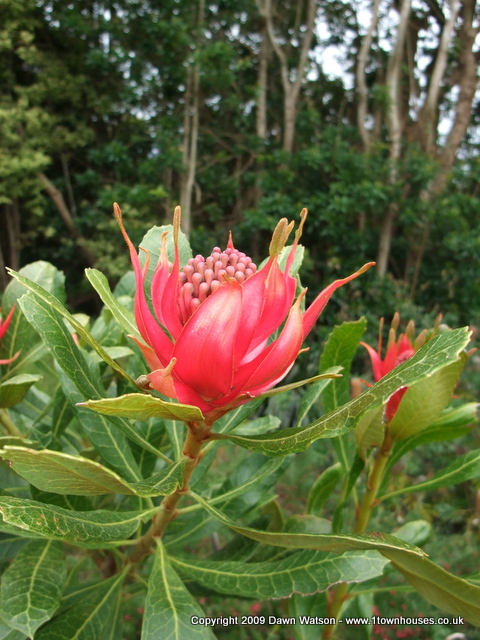
and were in for a bit of a surprise. Mixed general scenes were sharp
and attractive but significant areas of red or orange were somewhat
overcooked. Far from being sophisticated the F200 is a bit of a
raver and returned some lurid versions of the brighter exotic plants
which were way outside the realms of normal white balance latitude.
Especially close up it appeared to allow red, and to a lesser extent
blue, to overload, rendering deeply coloured areas posterised and
short of texture. At first I thought that it was simply poor flash
control at close quarters but some shots of a chicken's comb at well
over a metre away were suspect too. Of course I'm being forensic to
review the camera, most normal people wouldn't 'pixel peep' like
this, so it may never bother them.
|
|
Macro
aggro
Another
thing which became apparent amongst the flowers was that while the
macro performance is good on paper, down to 3cm, as soon as you zoom
in that's long forgotten. By the time you are fully zoomed in it
can't focus much less than half a metre away. Some cameras nobly
maintain the minimum possible distance at each stage of zoom but the
Fuji, like many, makes a sudden step up. This severely limits what
you can do close up, but it's not a unique failing. You hit the
happiest medium at around 1/3 zoom but basically you have to get
closer for more magnification so there's hardly any point zooming in.
It's simply not a great macro lens though the results are very sharp,
there's nothing wrong with the quality of the optics.
Battery
life
The
battery in the F200 is pretty small, barely larger than those in some
of the smallest cameras so it's no surprise that it has limited life.
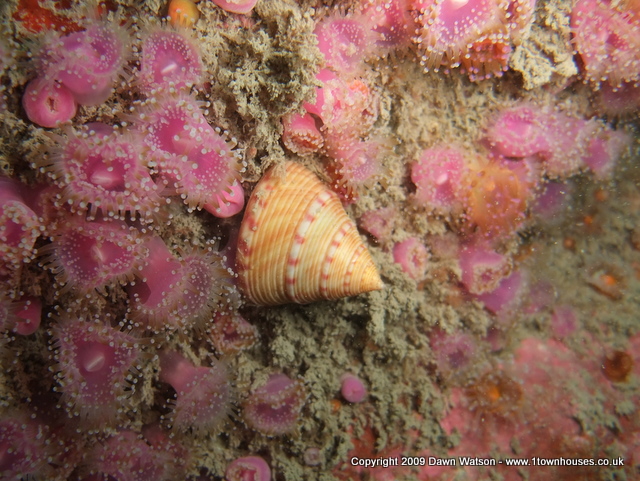
On a surface day out the F200 lasted for 206 shots, including lots of
fiddling with menus and plenty of flash use. That might translate
into approaching 250 shots for a careful, normal user. It's far from
spectacular but easily lasted for two 50 minute dives. Dive usage is
quite different from land as the camera tends to be on almost
permanently and flash is often used all the time – but there is a
gap of 2-3 hours to recover between dives. Most impressively the F200
showed no signs of fatigue even toward the end of the second dive and
the flash was still cycling impressively fast – easily fast enough
to cope with moving from shot to shot every few seconds.
|
 |
 |
Low
light, contrast and dynamic range
Around
a pair of castles on Tresco the F200 made a great attempt at some
very difficult interiors, dark walls with bright exterior views
through windows and sullen skies. Often it was holding detail in deep
shadow we hadn't seen with our eyes, whilst also coping with bright
areas. To do this it rarely dropped below ISO200 which didn't appear
to compromise quality too much but was a trick it seemed to rely on a
lot and many scenes which appeared quite unremarkable were shot at
elevated speed too. This resulted in a strange mixture of surprise
and disappointment where chance shots taken to see what would happen
were really quite good and easy shots taken to keep seemed rather
lifeless. Perhaps controlling the highlights and capturing the shadow
is all very well when required but like the child who can only play
one tune on the recorder the F200 really needs to learn when to try
something different.
The
F200 certainly does have good low noise and good low light
performance but I'm not sure it should be resorting to raising 'film'
speed whilst still losing light by increasing shutter speed and
closing the aperture way beyond what is required. If the ISO100
performance isn't better than the ISO200 and 400 performance then why
is it included? A curious user (i.e. me) might suspect something...
is this simply required because a limited choice of lens aperture
needs ISO to be the main mechanism for light control?
|
|
Brain
free operation
The
F200 boasts a whole heap of modes... including a 'Manual' mode which
is really very nominal – the aperture can be set only fully open or
closed. That's 3.3 or 9 at wide angle and 5.1 or 14 zoomed in –
absolutely no use for finely balancing strobe and ambient light. A
three stop step (1/8 or 8x as much light) just isn't a fine
adjustment. Clearly the emphasis is not on independent creativity,
but it encourages safely guided fun through its various scene modes.
Most
of the modes are generic to almost all consumer cameras now...
sports, flowers, night, portrait etc. but the limits are some of the
most prescriptive I have come across. In sports mode you aren't
allowed to engage macro, so you can't put two and two together and
decide that it might be the mode to capture fast moving small
animals. In flower mode you can't engage flash so the night garden is
off limits. Why this level of obstruction is required I really don't
know. Maybe there is a setting to remove the training wheels but I
simply couldn't find it.
The
F200's piece de resistance is its eponymous EXR mode which is such a
full auto that it will try to sort out your life completely.
Apparently this is a full time job and it sets to work adjusting
itself continuously even when set down on a table pointing at a
static scene. I'd imagine this would hammer the battery life, the
same way continuous auto focus does. It's also very annoying to have
a camera that rattles and clicks as though it is operated by
clockwork. If the results speak for themselves perhaps this could be
forgiven but underwater waiting for the camera to shuffle around was
a bit of a non starter – so it was ignored there. On rare sunny day
I turned the dial, which is very easy to spin as you pick it up, to
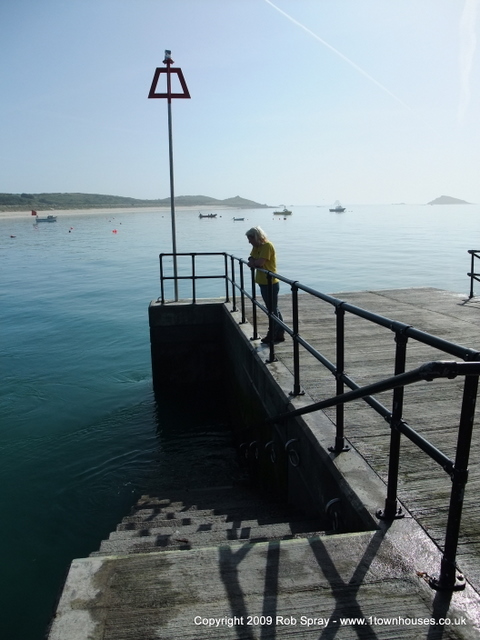
EXR and watched it cope with extreme highlight and deep shadow around
a concrete quay and glittering sea. Shooting into the sun or shadow
the camera switched modes to keep exposure under control under real
duress. This was a real tour de force of the EXR sensor, holding onto
a blazing sky behind a badly lit smiling face. Boats which were
silhouetted in the bay weren't flat black or eroded by burnt out
highlights. A really impressive performance – great dynamic range,
highlight control and clean shadows with detail. This makes it a
great bet for days on the beach and stunning sunsets but on its own
terms, the F200 does not encourage interference.
|
 |
 |
Dive
dive dive
In
searching for the best initial setting for use underwater I was torn
between Program and, to my horror, the Noddy Underwater mode. There's
not much to choose really but if you do slide around to P you can
select goodies like centre focus, spot metering and exposure
compensation. In Underwater mode control is severely limited – you
can go to the ISO item in the menu just to discover you can't change
it!
The
F200 is also impressively fast for a compact. Focus snaps in
predictably and accurately. Underwater the yellow focus confirmation
generally means sharp results, which is good as it's hard to hold
half pressed. This makes it very useful as a note taking camera, you
can move from subject to subject almost as fast as you can find them
– it has no trouble having the flash ready for the next shot.
In
general the best aspect of the camera is its build. The fit and
finish is excellent and the controls are pretty crisp – but they
are also very small. To add spice most of the controls are also
concave and need the precision of a finger nail to operate. I have
small fairly hands and even the tip of my index finger can cover the
four way pad and menu button entirely. I'm not sure what someone with
big banana fingers would make of it! In the dive case this isn't so
much of a problem but the buttons are still very close together, the
dial remains small and in thick gloves with cold hands using it is
harder than it really needs to be.
|
|
The
Strobe
The
cute little slave flash which can be bought as a set with the Fuji
underwater models is another idiosyncratic beast. It is small in its
housing and truly tiny in the flesh. Although its minute size gives
the impression that it's a bit of a Christmas cracker prize the unit is
actually metal cased and surprisingly well made. That's relative
praise as no one could really expect a £100 slave strobe (underwater
a flash is called a strobe!) to be made well but it's not bad for the
price. Considering the mount, a flexible arm and tray, are thrown in
for just £45 more it's a really neat, complete package.
Unsurprisingly
it has few controls, and some of those show that it's a very generic
piece of gear. For example it can be set to fire with the 1st,
2nd
or 3rd
flash from a camera – very versatile. Many digital compacts use a
pre-flash to help judge scene exposure so any slave needs to ignore
it. Syncing with the 2nd
flash suits the Fuji and with the 1st
might suit a true manual mode - I'm not sure which models would use
3. As well as setting to sync with the Fuji, it can also be set to
'Auto' or 'Off but On' – this second setting would be to stop it
firing when you didn't want it but would rather not turn it off. This
seems to add another control for the sake of it – the slider for
the pre-flash sync selection is the real power switch.
The
'Auto' setting may give some people the wrong impression. This unit
is a simple slave which is fired at a preset power whenever the
camera flashes. You can select one of three power settings -
amounting to flat out, minimum and half way between. Perhaps there's
a around a stop between them. The strobe is simply fired at your
choice of power in time with whatever the camera does. In any
automated mode it will simply add light to the scene – no bad
thing, but with no regard to what that scene is. This is a manual
flash and asks you to judge by trial and error how much light to add.
If you need less light than the minimum setting there is a choice of
diffusers. These fiddly sheets fit in a fiddly panel which clips onto
the front of the unit. I can't see this lasting long under any kind
of duress and with more than the mildest diffuser plate in I'd be
surprised if the strobe was more powerful than the built in flash...
in which case the job of adding more light won't go too well.
Even
though it only holds a pair of AAA batteries the strobe is easily
able to fire full power as fast as the camera can cycle its own flash
– the green ready light never goes off – so it's very well
matched in that regard. The controls on the unit need a dig with a
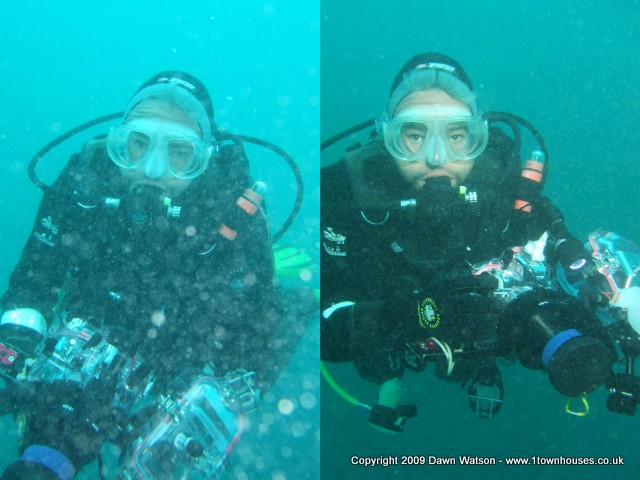
finger nail and those on the 60m rated housing are very small and
hard to use with gloves.
The
biggest weakness of the system, as supplied, is that there is no way
of triggering the flash without the internal flash lighting the
scene. This kind of triggering relies on enough light being reflected
back from the scene. So it's not 100% reliable and on top of that it
doesn't reduce backscatter much either. The camera has to fire
anyway, perhaps at a slightly reduced level as the strobe is
supplementing it, but in murky waters this is going to be almost
pointless. If an optical fibre was supplied to trigger the unit and a
plate supplied to blank the camera flash this would be a viable
budget system. Even then you would be using the system manually,
without the benefit of the camera's various clever systems, but it
would at least significantly cut back scatter. The diffuser holder
does have ports for a fibre but the camera does not, there are simple
ways to do it so that's not much of an obstacle. As it stands it is
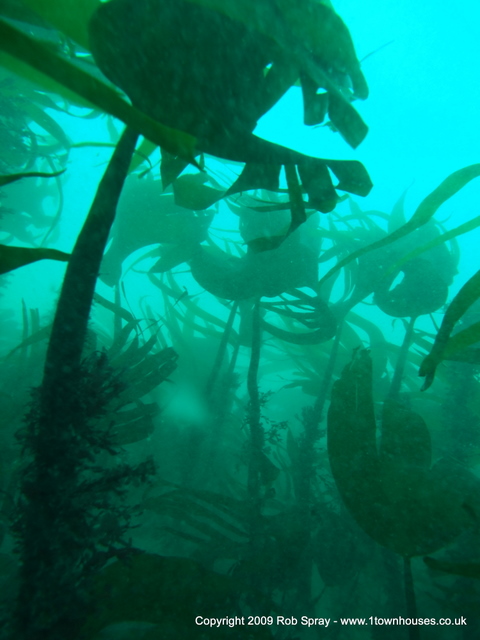
suitable for very clear water only.
|
 |
|
Conclusion:
As
a camera for the well heeled surface traveller the F200 won't
disappoint for general use. It is fast and, at a high level,
responsive and nice to use. Unfortunately digging deeper isn't
rewarded as most of the magic is only available in automated modes
and trying to go your own way won't get much better results.
The
F200 EXR still needs some polish to be an unreserved success. It
looks and feels accomplished but has odd lapses – the 2 position
aperture for example – and it really, really wants to interfere.
I'd happily recommend it for a technophobe who has a penchant for
museums, sunsets and indoor events. It makes a good fist of that most
difficult of roles - the camera that can give good results within
seconds of being picked up by a novice. The problem may be that few
novices are demanding enough to notice the subtle benefits which the
F200 can offer whilst the more experienced may find it frustrating. I
have to concede that I am a camera nerd and maybe these days a lot of
people don't have the time to learn how to work all their toys and
Fuji have guessed right and the F200EXR is the best tool they could
have for their snatched photos of their busy lives.
Underwater
the case is excellent, aside from the small buttons, and the F200
remains easy to use. Its tendency to elevate film speed even under
close up flash can be overcome in Program mode and it is fast and fun
if you don't need to do much macro work. The strobe set isn't ideal
for the UK and I'd suggest this package for tropical divers only as
our home waters really need more advanced gear. Strobes are a
complicated area and this is very basic, perhaps worth considering as
a cheap taster before you take the plunge and buy a more capable
system.
On
land
Pros:
Fast, well built, strong totally auto camera work for a normal user,
good in low light, low noise at high ISO. Retains highlights
tremendously well.
Cons:
Over enthusiastic reds in strong or flash light, poor macro
performance in practice, complex menus, interfering scene modes,
crippled 'Manual' mode, tiny buttons.
Underwater
Pros:
Tough very secure and easy to maintain housing. Small and easy to use
major functions. Accessory shoe for lights etc. Good value package
with strobe.
Cons:
Macro limited. Flash coverage uneven and flash control unreliable,
controls too small for cold, gloved hands, no shutter lever. Boxed
port limits additional lens options. No remote link for manual only
strobe.
|
---------------------------------------------------------
Vivid Oceans and Secret Seas
www.1townhouses.co.uk
|