 |
 |
 |
 |
 |
| UK
Diving |
Tropical |
Temperate |
 |
Trip info (on its way) |
Using the Olympus ZD 12-60mm ED SWD underwater - picking a port and homebrewing a zoom gear
|
||||||
Moved to an SLR and the
lack of a good general purpose lens getting you down? Torn between
macro and wide angle on every dive? Join the gang, there's no cure!
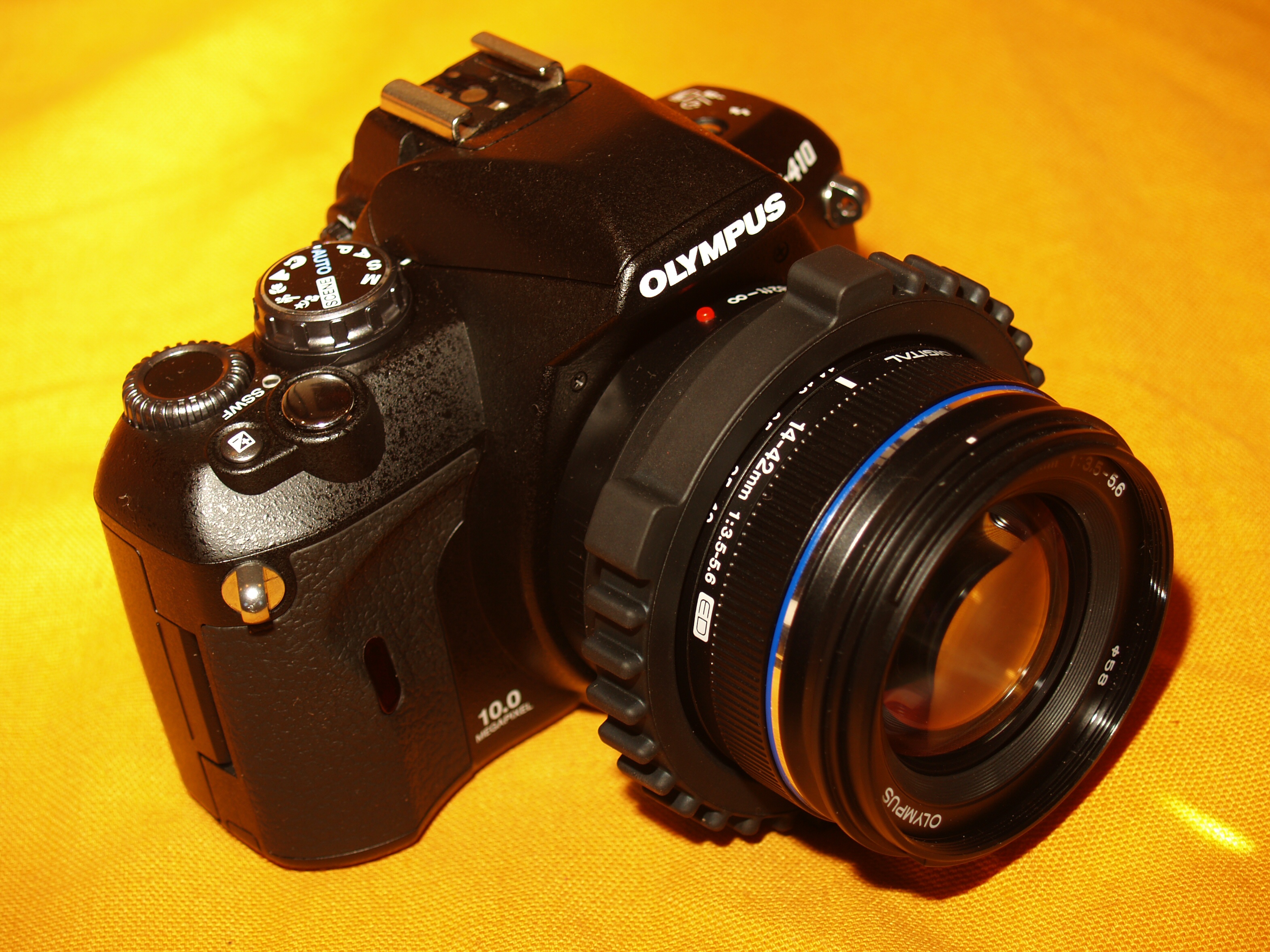
Well there's the old standby of using a kit lens... but not just any kit lens. Some are body stoppers not even worth box space but if you broaden your idea of 'kit' and look up the range you might find there's something that fits the bill. Olympus' standard kit offering is a 14-42mm midget which is good on land but no scene stealer underwater, it's sharp and tiny but lacks range. Behind a dome it is usefully wide but lacking at the long end (only 84mm equivalent). No one said the lens had to be in a kit with your camera? These days baby SLRs are great value and give away little to their bigger range mates but to keep them cheap the 'kit' lens is built to a price. I like the little Olympus but if you look upward at what the E-3 comes with then you'll see what a 'kit' lens could be. The 12-60mm it comes with is an optic which has got rave reviews. A 5x zoom which isn't really compromised, for land use at least. Any port in a storm When you come to wonder about taking it underwater the line from Oly is that it can't be housed. To pack in the range the lens extends nearly 3” from wide to tele and so it doesn't sit nicely in any normal port. So to be housed the no compromise lens will have to make do. The lens can be housed behind the dome port for the 8mm by adding both the extension rings for the 1.4x teleconvertor and the 7-14mm. In fact if you already have the 7-14mm you can fit the 12-60mm straight in if you limit yourself to 50mm. In effect this means that many people already have the parts to house the lens – Olympus approved or not. The lens can focus within a few cm so there's no need for a close up lens to work behind a port. If you want to work behind flat glass the 14-42 port on the end of the same two extensions will allow you to use most of the range but will cramp the wide end – the equivalent of 24mm which is beyond the usual guideline limit of 28mm before problems start. Time to DIY So taking standard Olympus parts you can make a working port but as its not a favoured lens there is no zoom gear for it... but you can make one so that you can exercise the port options for yourself. Most of the current Olympus zoom rings are rubber mouldings made specifically for each lens so they aren't great for mixing and matching but the spare gear for the 14-45mm, which I've never used underwater, is a hinged plastic bracelet and looked useful. With a bit of bending and squeezing it fits on but won't quite close...but a loop of thin bungy can be used and works. Unfortunately this makeshift ring squeezes the lens making it stiff and difficult to turn... which in turn grinds it against the teeth on the zoom control. While this might be bearable in the larger case for the E-330 there just isn't room for the gear on this fat lens inside the smaller PT-E03 for the 410 (the E-420 too with mods of course). So you're on a desert island and want to use this lens with the small housing you've carried 8000 miles? Read on... Basically the zoom ring needs to be thinner, to fit between on the lens and the port ring on the housing. Whilst its tricky to so how much space exists when everything is assembled it helped to have some other rings about. From comparison it was clear that the teeth only need to be about 8mm wide, where the 14-45 ring is about 15mm wide. So I thought I'd try taking a third off the width of the whole ring, which trimmed 5mm off the teeth. This looked to be a difficult job but five minutes with a hacksaw and a driftwood branch of suitable diameter and the job was done. A much better, more flexible, if not perfect, fit once suitably secured with bungy. As the ring is thinner it grips the lens less tightly and the teeth actually align and mesh much better so the action is far smoother more pleasant to operate. In the water Underwater the doubly extended port makes for a big snout on the little case for the E-420. This isn't a handling problem as on Olympus housings the thick aluminium of the ports makes them as strong any part of the case and reasonably neutral. The best surprise is that the port works really well optically. With a quick adjustment the shade/dome guard moves out of sight and that beautiful glass bubble doesn't seem to distort the view. Logic dictates that there should be problems but I think the water outside the dome makes a bigger impact than the glass – as it should be. The wide end is very useful, nearly 90 degrees (84 actually). Whereas the 7-14mm can sometimes feel like it makes the world just too far away 12mm is a good wide angle and the option to run up to 60mm gives you a lot of options. Out in Sangalaki the morning manta run was a great match for it. Sure a 7-60mm would be nice but I think that might be larger than the dome and port! So it was usefully wide and able to reach out a little when a pseudo macro subject swam past. One of the surprises for my dive partner was that even with small subjects the focus was razor sharp, meaning crops were viable for ID and maybe small prints where hers were softened when viewed at 100%. I think the main reason for this was that the other thing that makes the lens interesting, for Olympus people at least, is that it is the first of their SWD – fast focus – lenses. So it snaps into focus very fast and as it turns out very accurately, making it a pleasure to use. Some of it's speed is only accessible with the E-3 or new E-30 but most of the improvement is quite obvious with the E-420 too. It even has the effect of making the Live-view mode on the E-420 more useful, not snappy but at least useful. I used it to lower the camera into a space in the coral for an upward view of a cuttlefish which I couldn't have taken by viewfinder. As a top tier 'kit' lens it is brighter than the cheaper glass too - running from f2.8 at 12mm to 4.0 at 60mm. This is a lens which can be used wide open, so this isn't just a viewfinder and focus bonus. You get used to that with the Olympus optics but it's worth stating as many lenses look good on paper but have to be stopped down to be sharp. Conclusion Finally liberating the 12-60mm for use underwater has me kicking myself I didn't do it sooner, it is such a fast, versatile lens. I haven't used it much behind a flat port but hope that will prove my suspicion that this lens with a dome and flat port might be more than enough for most SLR divers if they were travelling light. There'll always be a need for my favourite wide and macro lenses but when you need to cover all bases but can't carry everything this is an option I'm very glad I have. Lens spec: Focal length: 12-60mm
(24-120mm film equivalent) - 85-15 degree view Port spec: Uses PER-E01 and PER-E02 to space either PTLH-E01 dome or PPO – 05 flat port. Compatibility: Lens compatible with all 4/3 bodies from Olympus or Panasonic, port compatible with all Olympus housings PT-E01 to E05 – Also BS Kinetics housings with bayonet to threaded adaptor. Athena make additional port options – they are the original source of many Olympus parts.
--------------------------------------------------------- Vivid Oceans and Secret Seas www.1townhouses.co.uk |
||||||
|
|