 |
 |
 |
 |
 |
| UK
Diving |
Tropical |
Temperate |
 |
Trip info (on its way) |
Going Live - The Olympus E-330 underwater
|
|||||||||||||||||||||||
|
Going Live – The Olympus E-330 underwater Before now, BN, there was a gulf between the two castes of underwater photographers. The distance was a measure of commitment, money and for some ideology. You were either a compact snapper or a serious SLR toting ‘photographer’. Of course it isn’t as clear cut as that, but that was the bottom line as far as boat kudos went. But that was BN, or more precisely before the E-330. Even a year after its launch it remains unique, it divides reviewers but has no direct rivals. The weird thing is that what makes it so unusual goes unnoticed when people ‘give it a go’. Serious phototypes baulk at its looks more than the moving picture on the big 2.5” display, normal people find nothing remarkable other than the lack of zoom controls that any SLR implies. So here is a camera which has a USP that no one notices - a tough break. It’s unremarkable because it works and part of the normal operation of most of the cameras on the planet. Some reviews have failed to see the point and that might be the case for SLR fundamentalists too. Maybe these people only photograph scenes they can view directly – pity them. Compact users never have trouble finding new ways to take pictures, holding their camera up, down or sideways at arms length or tucked somewhere tight to get their shot. I think there’s a message there, if you have an imagination you should read on, if you are happy with life the way it is pull up a rock, sit down with a good papyrus and enjoy some raw meat ;-) So enough of the life counselling, what’s going on? Well, the E-330 has full-time live view, actually it has two types. Both have their uses - one has parallels on other SLRs but the other is something new. It’s worth a quick explanation to illustrate what’s going on. SLRs, as a rule, can either view or take a picture. The moving mirror that gives them their name routes the image to either the eye piece or the sensor. This means that live view is normally impossible as there is no light hitting the sensor. An increasing number of cameras have a mode where the mirror can be held up, allowing the sensor to be exposed for longer, a ‘lock up live view’ - of course then the viewfinder doesn’t work. On top of that the big, sexy sensors used in SLRs aren’t designed for that and tend to warm up and get noisy if they are used like this so there is sometimes a time limit on this mode. So full-time live view is impossible on an SLR? So here we have a unique SLR which can do the thing beloved of many new diving photographers all over the world – show a big colourful live view of the world. Paired with a housing, from the manufacturer with the fullest support of its range underwater, and you have a very neat package for divers looking to graduate to the undoubted advantages of an SLR underwater.
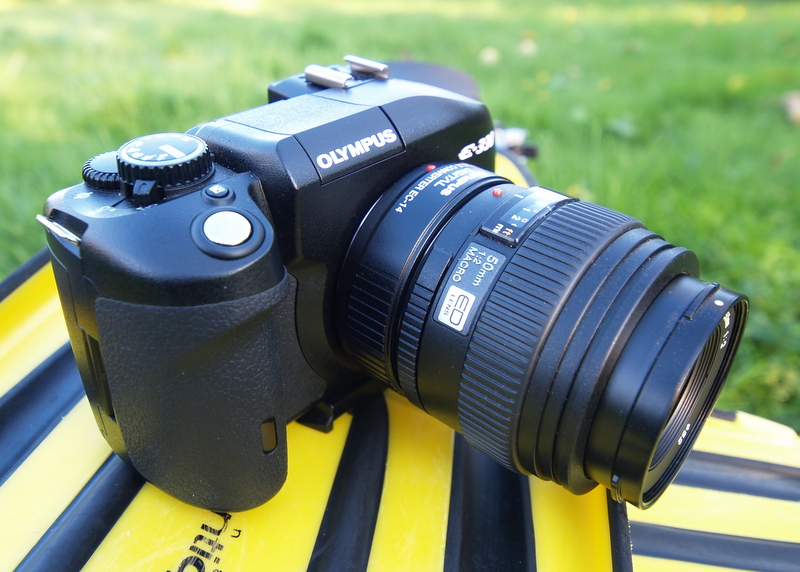
So what’s the deal? The camera and the case are often sold as kits, which include the standard 14-45mm lens and a suitable port respectively - although all parts can be bought separately of course. Prices are always in flux but the camera was around £500 and the case £1200 last time I looked. After buying the kits there are endless additional possibilities and instead of just a camera and case you can add your choice of lenses and a matching port for each. This can be tough as each lens is a compromise so choose carefully. I'll run through the parts of the kit and what you'll need to consider. The body: The E-330 is an unusual looking SLR because the cunning side swinging mirror which allows it to hide the extra sensor gives it a flat top. But it’s a reassuringly solid feeling plastic lump with a significant handgrip and pleasantly non-slip surface. The controls are clear and reasonably arranged around the centre piece of the back panel – an articulated 2.5” LCD screen. The screen is bright and sharp but very shiny so it catches reflections easily. It can move in one plane - to tilt up or down - which is very useful on land.
Of course there are a variety of scene modes, including several for underwater use, but it can be used fully manually and every shade in between. There are few things you can’t configure - it was never designed as an entry level camera. Although there are only 3 auto-focus points which some regard as a demerit – the first thing I did was to disable the outer two so it wasn’t a problem for me, I like to choose my focal point myself. My only criticism is that as there is only a single control wheel in manual mode a button must be held down to switch control from aperture to shutter speed. It’s no problem bare but pretty awkward in the case. The image resolution is an odd 7.5 Megapixels, odd because it seems a slightly retrograde step after the E-300 and E-500 which were both a round 8. It was the use of the new LiveMOS sensor that necessitated the drop. In fact using RAW convertors 8 Megapixels are accessible. Counting dots is missing the point in any case, the difference is negligible and a good shot can be printed up to A2. Lenses Standard zooms: The standard kit lens isn’t bad on land but not the most versatile underwater, it is a 14-45mm which is the equivalent of 28-90mm in old money. Its weakness is the generous minimum focus distance of around 50cm, this is no macro lens. It would be feasible to use a 58mm close up adaptor but that would fit inside the case and couldn’t be changed during the dive. Olympus’ newer kit lens – a tiny 14-42mm unit – focuses much closer, as does the 14-54mm from their Pro range. But buying an SLR is all about the opportunity offered by specialist lenses, so I'll concentrate on those :-)Macro:
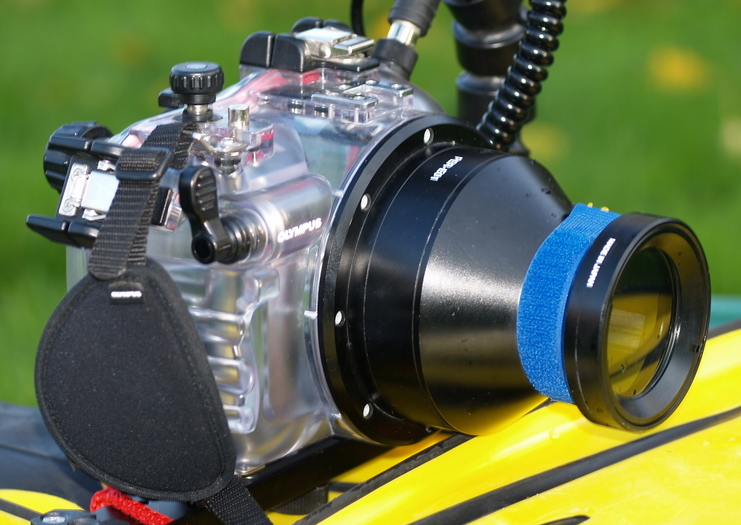
The first choice upgrade lens is probably Olympus’ f2 50mm macro. It is the equivalent of a 100mm lens on a film SLR and it has a matched tapered port which is very compact. For extra magnification it can be paired with an extension tube or 1.4x teleconvertor. The latter is preferable, though more expensive, as you remain able to focus at distance - both need a port extension. The 1.4x and 50mm is now my weapon of choice for macro photos as it allows very close focus and considerable magnification.
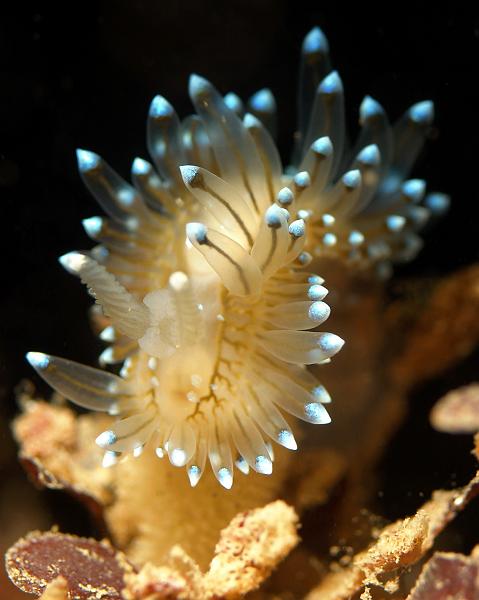
There is also a very compact 35mm macro lens which offers even greater magnification, if you can get closer. Excellent for slugs but not so good for fish portraits – a compromise. It is considerably cheaper than the 50mm but needs a bit more light.
Wide angle: After macro comes ultra wide… Olympus have no handicap when it comes to the quality of their wide angle options but there are no third party lenses on offer so you pay for their glass or to stick to the mildly wide view of the standard zooms. The cheaper option is a fixed 8mm fish eye which covers 180 degrees diagonally. For this and its 7-14mm range mate you’ll need a dome port. It’s a recurring theme… it ain’t cheap but it’s a superb piece of kit. It’s a glass dome as you’d expect. There is also a very well reviewed 11-22mm. I haven’t tried it, I’ll merely pass on that, like the 7-14mm, it is rated as good as a prime lens (one of a fixed focal length) even though it is a zoom lens, which is a rare complement.
Top of the range is the remarkable 7-14mm lens. It’s the widest ‘made for digital’ lens available. Unusually it’s not a fish eye and has very, very little distortion although the ultra wide perspective does mean objects at the edge of the picture are prone to stretch. The other thing which may have to stretch is your wallet, this beautiful lens costs around £1,200. Many people have bought Olympus SLRs just so they could use this lens and after you have tried it you may well agree. It is actually surprisingly difficult to use a lens like this in everyday photography - but that is not what it is for. This is for those unique shots which capture a whole scene, a whole site or defeat impossibly bad vis. In film terms this is a 14-28mm zoom. You cannot match this unless you use a full frame SLR such as a Canon EOS1 or Nikon D3 – those cameras cost much more and the lenses are no cheaper!
Strobes: There’s no room to raise the pop-up flash in the case so it can’t be used as a trigger for slave units – at least without modification. Thus the only option is a cable connection via the 5 pin bulkhead port. This is Olympus’ own unique connector and they make 2 flash and case combos which can be used with it. I diverge slightly from the Olympus scheme at this point as I think there is some room for improvement. There are also several options for third party flashes.
I have tried both and there are some important pros and cons of the own brand units. In their favour they work superbly and have extraordinary delicacy of TTL control. In addition you are not restricted to typical SLR sync speeds (often slower than 1/200th second) and are free to go up to 1/4000th of a second - even compacts can’t do that! On the downside the FL-20 isn’t very powerful and whilst the FL-36 has higher output it saps the pair of AA batteries which power them both even sooner. Both are bulky in their cases, the FL-36 to a striking extent – it’s 60m housing is 10mm thick, quite overwhelming the little Olympus arm which can barely control it. It's a better mate for ball and joint or large diameter flex arms.
The third party options work well but are restricted to mortal sync speeds (1/180th second) and are much more limited in their TTL capabilities as the E-330 uses a very fast pre-flash which most units cannot recover from. I might be tempted to operate in manual until you could afford an Olympus unit to TTL drive a slave unit. The Housing:
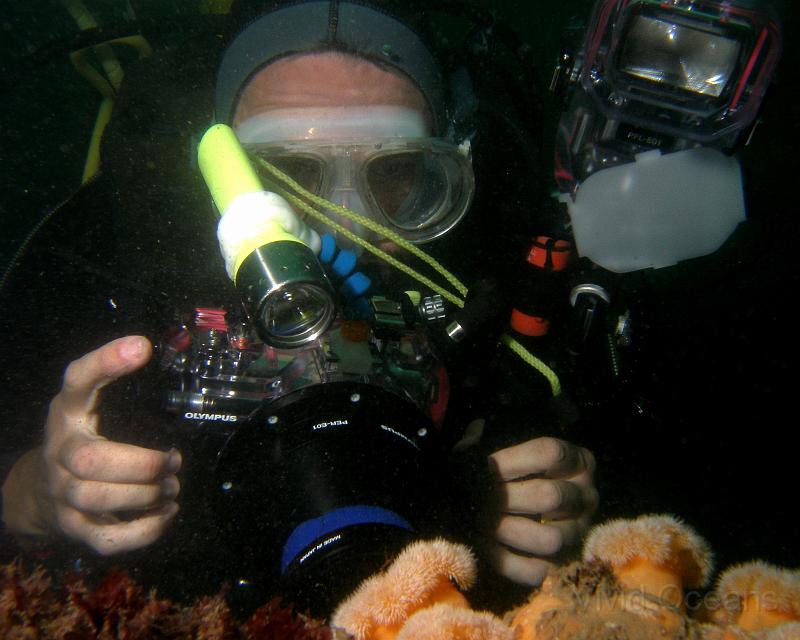
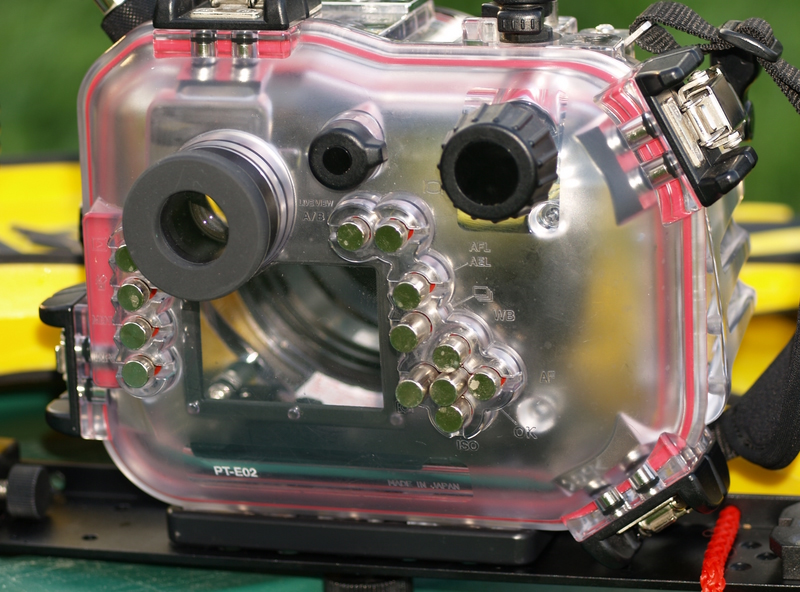
The E-330 fits very neatly into the PT-E02 case, it is nicely made and if you’ve used one of their compact housings you’ll notice how everything is somehow the same but bigger, better and tougher. The camera slides in on a locking sled without a great deal of air space. The strobe cable slides on and the mode control is engaged and you are ready to lock the case down. 4 sprung over centre catches hold the back on and compress the two large red o-rings. All the camera controls are brought out individually, none are shared. The only facility missing is the option to unlock and remove lenses without taking the camera out of the case, as you need to remove the port to do this you wouldn't save much time.
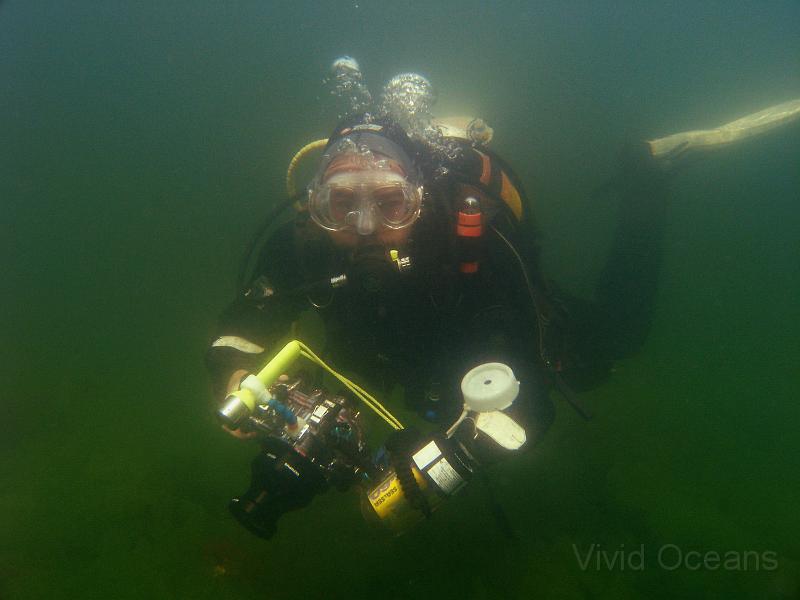
The black anodised aluminium lens ports have a deep thread and a fat, signature Olympus, red o-ring. These are stiff to turn once the o-ring is engaged and a cheap rubber oil filter wrench is a boon when the ports need swapping. All the port windows are glass. The construction is beyond reproach, which explains why these are not a cheap option compared with the polycarbonate ports use with some housings. There are also some third party ports, made in Japan by Athena, which allow extra mega macro options. These are more expensive still but also superb – it’s that recurring theme again. The case allows the manual control of only one ring – focal length for zoom lenses or focus for primes. The case mounted gear can only reach the rearmost ring on the lens so manual control is not possible if the extension tube or teleconvertor are used. The Athena macro ports come with extended gears which do allow this. Although the case/camera combo is pretty large it’s not big by housed SLR standards. The thick polycarbonate case is on a par with smaller metal housings rather than the angular Ikelite offerings. It’s worth mentioning that there are other cases for the E-330 from 10bar (also sold as Fantasea), Ikelite and Aquamir so there is no shortage of choice. Battery life: After the C-7070, which had truly epic battery performance - easily lasting a tropical liveaboard day, the E-330 might have been heading for a fall but I have been pleasantly surprised. Battery life is excellent, using the optical viewfinder undoubtedly helps, but we have only reached its limits underwater on very long dives. Around 3-3 ½ hours, over 450 pictures and 6GB of files seems a very good performance from a conditioned but well used BLM-1 battery. It certainly seems to better some SLRs, such as the Canon 400D, which I’ve seen being fed new batteries on a per dive basis on liveaboards. I’d be inclined to feed it every couple of hours or dives to play safe. In use: I baptised the E-330 in Holland. I know there’s a few of them taking to the water in Europe but they are far from routine so it attracted a lot of attention. Although the rig is heavy out of the water the bulk disappears once submerged and I was very quickly at home. Although live view is this camera’s USP I soon found myself switching subconsciously to the viewfinder and back as though I’d been doing so for years. It was striking that some scenes and subjects are easier with the viewfinder – it’s certainly more precise and accurate framing tiny stuff with the camera steadied on your head… whilst others benefit from distance and a free view of both the subject and camera. I’m sure a purist could complain that both options were compromised but they wouldn’t have both options. It’s a shame that the articulated display can’t be angled under water in the standard case (it can in the Aquamir) but that would make access to viewfinder tricky (the Aquamir cannot use it).
Although I was conscious that the live view might be poor in low light this wasn’t the case even on some very murky dives. One of the most useful uses of the live view was to arrange lighting from torches which certainly helped focus under tough conditions. Where the conditions made the LCD view indistinct I simply used the viewfinder and didn’t find that dark at all. It was a treat having a ‘real’ view for macro focussing and I was impressed for the most part at the new degree of control over macro which opened up in comparison to the C-7070 and Inon close up lens I was using before. This kind of picture taking is still challenging but the strike rate is greatly increased with the SLR. We dived with the E-330 set up for wide and macro shooting and aside from the lens changing it was just like preparing for diving with a compact – only bigger! The drill of ‘o’-ring and strobe connection checking is the same and in some respects it’s easier to line up larger catches and more reassuring to see bigger ‘o’ rings evenly ‘squidged’ thru the transparent case. Changing the ports to match the macro or wide angle lenses is a little more of an effort than screwing a wet lens onto your port but with the aid of a filter (oil not photographic) wrench its very easy. Both the 7-14mm and 50mm with 1.4x convertor need an extension tube but these assemblies can be left intact and swapped over whole once they have been screwed together – of course nothing that goes into the sea should be left unchecked for long I just mean its not part of the daily routine. The dome port for the 7-14mm is a whopping great thing and looks like a cooking utensil to a diver used to small snappy cameras. Of course it’s par for the course size-wise – it’s a 6” dome – and rumoured to be made by Athena who make the best domes and supply many housing manufacturers. It hard not to spend time simply looking at the crazy world reflected in the surface but after that paranoia sets in and you are very concious of all the spikey, scratchy things which could damage it. Being glass it’s not as vulnerable as a polycarbonate dome but then it does cost 2-3 times as much, gulp. The pre and post dive routines now include fitting and removing the dome port’s ‘knickers’ – a neoprene cover – to minimise the risk. As a dive couple who’ve managed to scratch the tiny port on a compact I’m painfully aware that these things happen. Thankfully most damage disappears underwater I’m told…
The port for the macro lens is a much subtler affair, giving the housing a less imposing ‘pig snout’ which enables the whole rig to get into tight spaces and cuts down on any shadow cast by the port. It’s a well tailored setup and probably too narrow for most other lenses - which would require a selection of the extension tubes in any case. One Olympus concession to the diver on a budget is to offer the use of a flat port with some of its mid-width lenses. There is a flared port for use with the 11-22mm and 14-54mm lenses, this has wider, flat window which doesn’t vignette the view of either lens. Light passing through glass at angles beyond 75 degrees suffers from increasing diffraction (as well as the 25% increase in magnification =25% loss of view width) so I haven’t seen anyone recommend these, I guess this is best considered a utility port allowing no loss at the tele-macro end of the 14-54mm and compromise use of both at the wide end. Both lenses can be used with the dome port, which makes a lot more sense for wide angle. The ‘kit’ port is designed to fit the ‘kit’ 14-45mm lens. Because it is such a tailored fit it doesn’t fit the slightly longer 14-54mm lens and vignettes the slightly shorter 14-42mm lens. That’s a bit of a shame and undermines the value of this port unless you have a particular need for it. The kit lens is good quality, quite unlike the suspect zooms in Canon kits but, as noted earlier, will not exploit the camera so plan your port buying carefully. One interesting point for the future is that each Olympus SLR housing has the same port fitting and lens mount datum so your lens/port pairs can progress from case to case if you change your body (the camera silly not yours by liposuction). Of course none of the detail above really matters. The technical side of photography often overtakes the real business of taking pictures. Of course I spent days wandering around the garden taking pictures of everything until my first dive arrived so when I took to the water I wasn’t surprised. 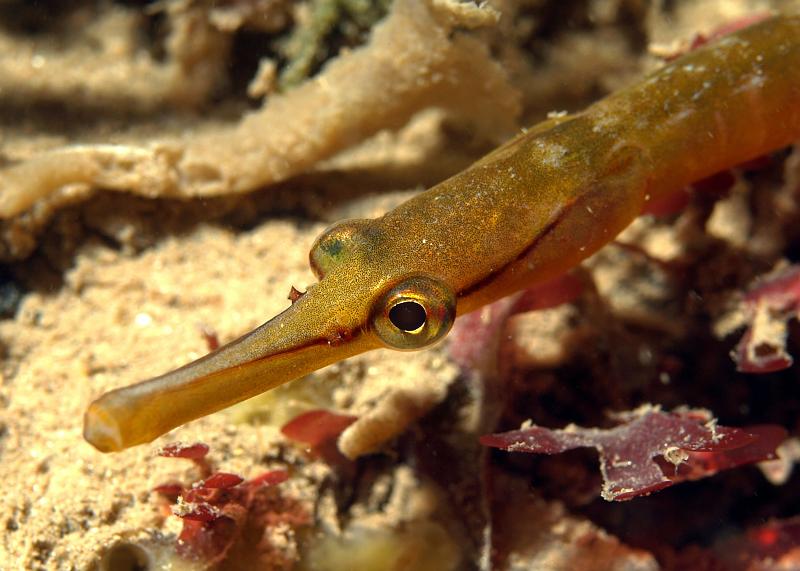 Coping with new stuff underwater is always a challenge but after a rocky dive where I expected too much instant improvement I was very at home with macro and started to use the viewfinder in preference to the display – but with the option to plant the camera off at an angle or down on the ground to get a shot. One aspect of SLR photography which shouldn’t have been a surprise was the effect of the increased aperture range and reduced depth of field. With a C-7070 one could set it to manual at 1/1000th of a second and F8 and a TTL flash would give a good chance of getting pretty much any shot within a couple of feet. It took some time for me to realise that I now have to trade depth of field for light in a way I didn’t notice before. That said the instant readiness for the next shot, snappy
focus and real-time viewfinder were changes I had no problem accepting.
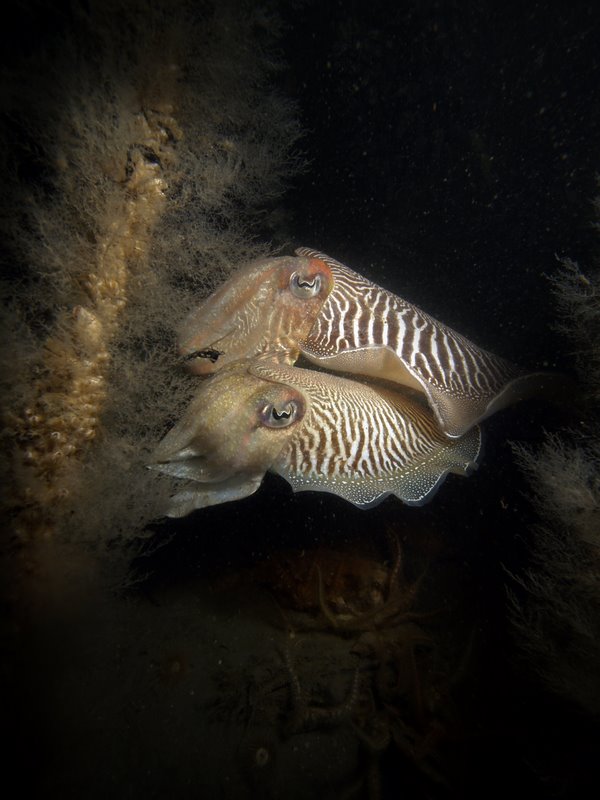
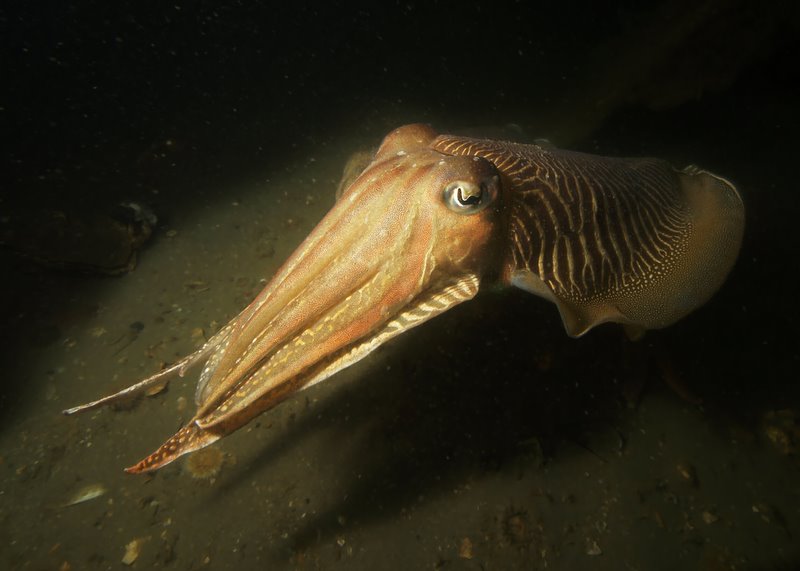
Whilst macro was an immediate pleasure it took longer to get used to ultra wide angle. The 114 degree field of view was way beyond what I was used to and really needed some extra thought about composition – otherwise everything looked too far away. A strong foreground detail helps anchor the rest of the picture unless there is a very marked structure to the background. This is common to wide angle lenses and no surprise when you consider that whilst you can take a picture of someone, top to toe, from less than a foot away there is a huge difference in the distance from each part of the picture. A wide angle lens also has a large depth of field which makes focus less critical. But it certainly came into its own in Holland. We went expressly for the cuttlefish
breeding season and the conditions were murky to say the least! Because of this
you really want to be pretty close to your subject. Luckily, and critically,
the cuttlefish are preoccupied so you can get quite close. Once you are very
close a wide angle lens is just what you need to take in the whole scene. So
having the widest possible lens let us get as close as possible, the lens can focus down to 10cm. This was a
godsend and allowed some stunning pictures.
One problem we encountered was that the huge angle of view made it hard to get the source of strobe light far enough out to avoid backscatter at the fringes of the pictures – clearly some longer arms are required… We found our own solution to that; Dawn swam above the scene with a slave strobe which was triggered off the wired one. It’s that kind of performance which really benefits from the live view as the whole scene; camera, strobes, lights, buddy and subject can all be marshalled. It doesn’t seem unnatural to an immigrant from the world of compact cameras but I’ve seen how the SLR equivalent – keeping both eyes open can also work. It’s just another option and like the Karma Sutra it’s not part of an exhaustive list just another position to try. Elsewhere we’ve sometimes struggled sometimes to find a use for our prize companion as it suits large confident or static subjects or clear wide views. But it’ll be our challenge to get the best from its spectacular properties. In clear water it’s going to be amazing for reefscapes and when we’re attacked by something huge we’ll be able take pictures of ourselves disappearing inside. Conclusion: Short on experience of competing SLRs I can’t say whether the E-330 is better or worse than others. The balance of review opinion seems to be that some competing systems focus a touch faster but that Olympus lenses are among the very best. As a package for the underwater photographer the E-330 makes a good case as an ideal starter SLR system with good long term prospects. The case system is very well tailored and more compact than the third party housings. There is already a good range of ports, which are more flexible than listed as in combination with port extensions many other lenses can be housed. In use the case and ports are easy to use and quite tough. The the proprietary flash connection is a weak area. It is well supported but its predecessors have been vulnerable to careless treatment and damage, I've made hundreds of dives with no problem but others haven't been so lucky/careful. Those on the PT-E02 and PFL-02 haven’t been sited with use on UK dive boats in mind. I’ll make simple guards for these connectors which will address the problem, but it would be good to see the bulkheads positioned safely in the first place. Spares and replacements are available so damage is manageable in any case. The range of flashes fully supported is reduced in comparison with earlier Olympus systems. In fact just as many can be used but only the Olympus ones will function fully. This is not really a full fledged criticism as no other SLR range can operate at such high speeds. The results have been really good, sharp, true coloured and clean. Operation is in a different league from compact cameras with negligible shot to shot delay and no speed penalty in choosing to use RAW format. Neatly you can save a full quality JPEG at the same time which covers all bases – readable everywhere and with full access to the ‘digital negative’. The large live view screen is a key benefit which makes the compact to SLR transition painless for photographers graduating to a larger setup. If you already have an SLR it may not be the compelling reason to change but using the optical viewfinder is no problem either. If you are starting from scratch the very attractive deals on the E-330 make it a good choice - a unique camera with perhaps even more advantages above than below the water. |
|||||||||||||||||||||||
|
|
|||||||||||||||||||||||
|
|||||||||||||||||||||||
|
|
|||||||||||||||||||||||