|
Like death and
taxes it’s impossible to avoid the feeling, as you look around a diveboat, that
every diver has a camera these days. This is the fault of Olympus
who pretty much created this market by making dive housings for most of their
models since the late nineties. Ever since the PT-003 for the C-900, they have
been in the vanguard and now there’s a great choice of excellent small cameras
from numerous manufacturers. The starter market has opened right up with decent
underwater cameras from under £200. While low end competition is cut throat Olympus are still ahead in the breadth of models they house,
everything from point and shoot up through the range to their SLRs. Having
seeded the market from the bottom it may now be the top end which Olympus will be bringing within easier reach. So far SLRs
have been both too big and too expensive for many, despite diver’s well known
weakness for reckless spending! To find out if their new kid on the block is
out of its depth we took it for a fun November weekend in Plymouth with the last of the good(ish)
weather.
The camera
One of the
promises of Olympus’ chosen 4/3 (pronounced
'four thirds') sensor system was that it would make smaller cameras possible.
In truth this has been rather an empty threat as the first four E-Series
cameras were no smaller than average. At last that has changed; the E-410 is
the smallest digital SLR available.

|
The E-410 is the smallest SLR you can get at the moment - and all the better for that too!
|
Handling one will bring back happy memories
for old lags with a film history. Its not quite a wafer thin, retro OM clone but feels dense and well built. Intrigingly its
actually lighter than an OM-1 body even including the kit lens. It’s definitely
not the bulky plastic monster that seems to be today's 'small' SLR. The E-410 is
such a rapid update to the physically identical E-400, that it is clearly the
model that was originally intended – adding Liveview and other refinements only
six months later. Although it is nominally the entry level Olympus
model it is much better built than the equivalents from other brands and without
having its functionality crippled in any way.
|
Beside the average sized E-330 it's clear how much smaller the E-410 and its new kit lens are |

|
The E-410, as its
name sort of hints, is a 10 Megapixel camera. The sensor is the same one used in
the E-510. Both cameras have had excellent usability and image quality reviews,
the E-510 adds in-body image stabilisation, more buttons and even more configuration
options as well as being bigger, more expensive and having the hand grip which
is de rigeur on most SLRs. Olympus only house the E-410 so whether you'd benefit
from those underwater is a moot point here :-) Both models have two card slots,
one each for Compactflash and xD memory, and can fill both or copy between the
two.
Kit lenses
To complement
this svelte body there are two new kit lenses. The phrase ‘kit lens’ isn't
normally one to set pulses racing but these are something else. The standard
zoom is a tiny 14-42mm lens - equating to 28-84mm in old money. For surface use
the telephoto option is a barely larger 40-150mm unit (80-300mm equivalent).
The standard zoom is sharp, light and focuses down to 24cm - it's a great
general purpose lens and a cracking starting point for use underwater. Most kit
lenses are makeweights, but this one is worth its weight in gold - although not
very much as its very light :-) only 190 grams.
The rear LCD is a
big 2.5” but doesn’t look gross on the back of the body since the sparse
buttons leave space for a decent layout and comfortable grip. Of course the screen
can present the Liveview but also does excellent service on playback, with the
first use I’ve seen of the orientation sensor to take full advantage of a
display. As well as tagging images portrait or landscape at capture it also
uses the sensor so that portrait pictures show full screen if you stand the
camera up on end. I’m sure there are other cameras which do this but it’s a
nice touch for an ‘entry level’ SLR. It doesn’t feel cheap or limited and you
don’t pay a premium for compactness.
 |
|

|
The housing
It's all very
well making a cute little camera but no benefit underwater if you're forced to
buy an expensive, bulky case. Every style has its place but a compact cost
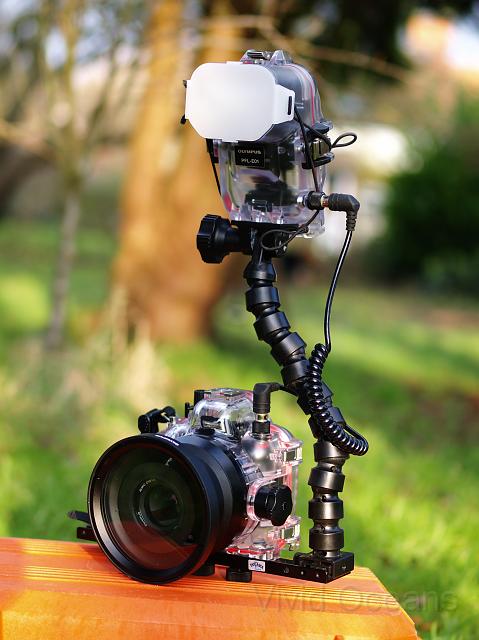
effective option is a great way to bring people into the hobby. Olympus’ previous SLR housings were heavy duty beauties,
rated to 60m and built to fight on equal terms with the big names in the field.
Now the little E-410 has earned itself a neat 40m case which provides all the
protection a normal diver will need to take it diving, the polycarbonate is
thick and rigid. The PT-E03 is clearly closer to its SLR brothers than its
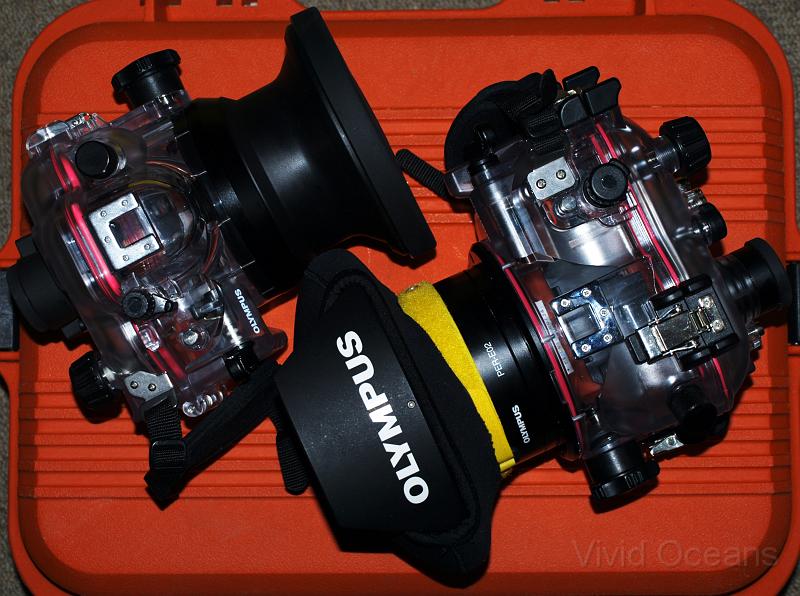
compact cousins but it still saves half a kilo. The pictures show how much
smaller the case is than the one for the E-330, which was itself a
comparatively small SLR housing.
|
A smaller camera means a smaller housing. The kit lens port has a larger frontage than ideal but might be
useful for under/over shooting. PT-E02 and
dome port on right for comparison. |
The case closely
follows the body of the camera but includes a power bulge so that the popup
flash can be raised. The port thread is the same as the other PT-Es but the
housing aperture tapers and has been reduced in bulk as far as possible. A
(relatively) mass produced case allows the creation of these specialised parts
where they are needed, so the drive to reduce bulk and cost can be done with a
conscience. The catches are smaller than on the other PT-Es but well proven and
protected from accidental release. Of course catches are only for the shallows as
water pressure holds the case shut at depth. It’s the rigidity of the case which
ensures the seals stay in even contact and keeping the case small helps keep it
stiff. Like the smaller Olympus cases the
PT-E03 is rounded rather than rectangular – to reduce stress and distortion. Double
'o'-rings seal the rear door which has a hinge on one side - which takes the
place of two catches on the other PT SLR cases. After greasing, the 'o' rings
need a while to relax into the detour over the flash but some time spent shut fixes
that.
| The power bulge for the flash adds to the height of the otherwise tightly
tailored case.
|

|
In a first for Olympus two camera controls aren't brought out, they’re
caught between the pop-up flash inside and the strobe bulkhead on the case and
so can’t be reached with reasonably simple buttons. One is the release for the
flash and the other is the drive mode button. Both are redundant and can be
accomplished by other means. Drive is one of the top level parameters - along
with ISO, white balance, flash mode, metering, focus mode, card, compression
and colour rendition - which can be accessed through the rear panel status
display. Just press the OK button and the cursor keys select the parameter you
can change with the dial. The E-410 is the entry level model in the range and
whilst it doesn't lack for facilities or image quality beside its larger range
mates the lack of real estate does mean less buttons - so users need to be
familiar with the back panel control options. Some reviewers have missed this
parallel control path, perhaps it’s not so critical on the surface but
underwater this simple aggregation is very useful under duress.
With the PT-E02 for
the E-330 I complained that the bulkhead connectors were vulnerable - they rose
above the top of the case and out to the side as well. On the PT-E03 the
connector rises vertically, tucked in beside the flash bulge. Used with the Olympus housed flashes their right angled plugs minimise
the chance of snagging the cables. It’s a much better arrangement, hopefully
the cases for the FL-20 and FL-36 with be revised to follow suit.
Underwater
On the surface
the camera and its cute kit lenses are great to use; fast and light - ideal as
a holiday or walking SLR. Underwater this translates into a body which occupies
little more space than a large compact - such as a C-7070. The port is
obviously a different matter but the kit unit is as short as possible, though
flared to eliminate vignetting at the wide end of the lens. It's not a compact
but quite clearly a size down from 'full size' SLRs like the E-330. We were
even asked which of the smaller Olympus
cameras it was. Underwater the 410 was good company and as the housing is rated
to 40m the buttons are more lightly sprung than 60m housings. I added a
Fantasea tray and flex arm to support my housed FL-36 and the combination
worked very well.
|
|

|
The wide end of
the kit lens is the equivalent of 28mm (75 degrees) and useful for scenery and
larger animals - including buddies! The 18" offset of the flexarm gave
good scatter free lighting even in Plymouth’s
5-6m November vis. The minimum focus distance might seem large to compact users
but remember it is quoted from the plane of the sensor. Although specified as
24cm I measured 20cm – which equates to only around 7cm from the end of the
lens when zoomed in. The telephoto end of the lens is the equivalent of 84mm
and so this gives reasonable near macro performance for smallish animals.

|
|
Unlike the E-330
the E-410 offers only mirror lock up live view, it doesn't have the extra
sensor to implement fulltime viewfinder type live view. Lock up live view can’t
use the SLR’s normal AF without ‘flapping’ the mirror up and down, which takes
a little time. It's in good company however, every top end SLR now appearing
has followed this trend, big Canons and Nikons included. Underwater this live
view works for wide views - albeit with a hefty shutter lag - but isn't really suitable
for macro subjects. This is the reverse of the situation on land, I think the
difference is due to the instability of a diver as a photographic platform, we
can't often hold still enough to use the live view for macro but the option to
compose with less timing critical scenes is welcome as it's often easier to see
the 2.5" display at arms length than to contort around to use the
conventional viewfinder. I found the E-330 live view more universally useful but
this version is cheaper and more compact so it has its compensations.
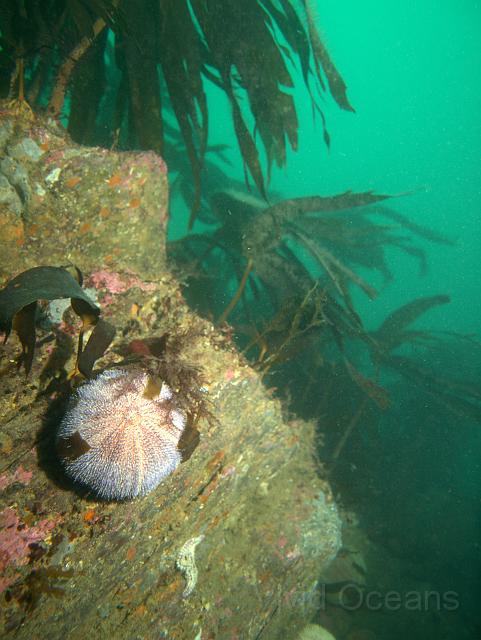 |
Liveview liberates the camera for scenic shots but isn't so useful for macro when the mirror delay gets in the way. |
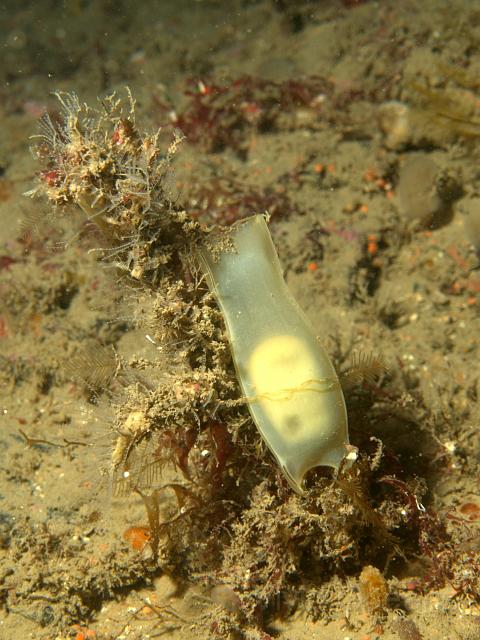
Much to
my surprise I was able to catch some quite small, mobile fish with the kit
lens, I had thought it might be slow to focus at the close end of its range but
it did a good job and I rather wish I'd tried harder after a few experimental
shots which turned out surprisingly well. The kit lens is a great starting
optic, very few of the lenses boxed with SLRs are worth the space they occupy
but the 14-42mm is compact and sharp which suits the E-410 perfectly. It offers
similar optical functionality to the 3x zoom a compact might have but has SLR
focus speed and quality – it’s surprising what a different that makes even
to mundane scenes.
|
|
 |
Accessories
The internal
flash can be raised in the case to trigger optical slave strobes. It doesn't
get high enough to clear most ports – in a pinch it might be just about OK for
fish portraits with the macro port - but that’s not the aim at all. Completing
a lightweight set up would require a smaller flash than the FL-36 I dived with,
though it was an excellent match. The housed flashes are conspicuously bulky
beside the PT-E03. Perhaps with this in mind Olympus
now have a small slave strobe on their books. It is clearly a Sea and Sea unit
which demonstrates a lot of good sense as they know a thing or two about
strobes. I hope the partnership bears more fruit as it would be good to have an
alternative to the housed land flashes. The UFL1 looks as though it is closely
related to the YS-15 but is slightly more powerful. Slave strobes are limited
to ‘normal’ flash sync speeds whereas the cable connected Olympus FL-36 can
operate at all shutter speeds up to the fastest, 1/4000th second.

|
|
An
attractive
budget add on to the set-up is a more capable macro lens, Olympus make
a very
light and inexpensive F3.5 35mm macro lens which will enlarge up to 1:1
(life
size at the sensor) which because of the 2x Olympus lens multiplier
equates to 1:2. The 35mm is the little brother of the very nice F2 50mm
macro lens Olympus offer. That costs 3x as much and is
much brighter but under water where greater depth of field is usually desirable
the only loss is some brightness at the viewfinder. The loss of light should
slow focus but the 35mm is actually pretty fast, it doesn't extend as much as
the 50mm and so there's less shifting required to rack through its range. It's
a good natured lens which happily seems to rest between shots within easy reach
of typical macro subjects. The extra depth of field seems to outweigh the loss
of light which in theory would slow focus. It's a good crisp lens but needs to
be used close up to exploit its potential magnification which limits the
subjects it’s suitable for – it’s better for slugs and sessile life than small
fish. The 35mm lens will fit within the port for the kit lens, but there’s a
compact macro port which suits it better.
|
|

|
Practicalities
The smaller body
does force the use of a smaller battery (BLS-1) than other Olympus SLRs and
that could potentially hit battery life, however it never ran flat on a dive or
when out and about. Use of live view and the internal flash to trigger a slave
strobe would both eat into the battery life but worthwhile improvements in
efficiency seem to have been made. My gut feeling is that it'll actually have
about the same life as my E-330, which uses the larger BLM-1 battery. On
our 2 dive per day UK
trips we had no sign of battery warnings but I'd expect to change batteries
once or twice a day on a liveaboard.
Dawn found the compact E-410 easier to handle underwater than the E-330, the
converse may be true for those with big hands, but the weight saving is also
worthwhile. The E-410 and kit lens weigh 2.5kg housed where the 330 in
equivalent trim is nearing 3.5kg. Once the E-410 was paired with a smaller
strobe such as the swanky looking new UFL1 slave unit the difference would
exceed 2kg. That’s a big difference if you have to hike a quarter of a mile to
a shore dive or pass the rig one handed up to a boat from a heavy sea. Of
course men won’t want their boat cred undermined by having the smallest SLR but
my girlfriend tells me that women are less hormonally vulnerable and can see
the advantages. She also tells me that size is important but bigger isn’t
better, I’m inclined to agree. A smaller camera is easier to manage and
position underwater, causes less drag in a current and hogs less luggage space.
We both felt that
the optical viewfinder seemed smaller than that in the cased E-330, on the
surface they are the same and the eyepieces in the cases seem identical so I
wonder if it was just a side effect of few dark days in Devon.
Certainly the viewfinder is small but no problem since the focus locked on fast
and accurately. The results straight out of the camera were strikingly sharp,
really popping off the laptop screen back at base. We took online advice and
turned off the default noise reduction at low ISO. There’s no need for it,
though perhaps the default re-sharpening could be turned down to match. Colour
wasn’t as strong as the rich rendition we’re used to on the 330 but we’ve had
longer to tune that to our preferences.
|
|

|
Another
interesting feature, which I haven't used before, is lossless RAW compression.
People often assume that all picture compression is bad but there are two kinds;
lossy and lossless. Lossy methods, such as JPEG, do sacrifice information but lossless
techniques don’t. Since mathematics allows this perfect compression there's no
reason not to use it... as a result whilst the E-330's RAW files are 13MB the
E-410 saves another 2.5 Megapixels in 9-11MB. That's a worthwhile saving at no
cost, I could fit at least 1000 extra pictures on my 80GB holiday hard disk :-)
At long last the on board USB is 'Hi speed' which does what it says rather
than the euphemistic 'Full speed' on earlier Olympus models which was olde
worlde, slow USB. It's not quite as fast as a card reader but does work in
storage mode so the camera appears as a drive on any Mac or PC without drivers
or software – thus I sometimes tuck scans of holiday paperwork on my cards as a
safety measure.

|
|
Conclusion
It’s usually amicably
agreed that the quality defining element of a camera system is the lens,
although bodies can have more or less features they can only exploit the light
that is collected for them. Choice of lens is the basic strength of an SLR
system and the E-410 is the cheapest, smallest way to access some excellent
lenses. That the kit lens is worth having is a pleasant bonus. Until now SLRs
have been a Visa bill too far for all but the keenest underwater amateurs. The
E-410 and PT-E03 don’t make the underwater SLR a cheap option but do trim a
good slice off the top. It’s still not chump change but knocking some 20% off a
typical setup will get more SLRs underwater.
The ‘Liveview’
concept has been watered down since the E-330 but remains a useful option. As
with the E-330 the optical viewfinder is the best bet for macro but the screen
can be great for wide angle. The E-410 is a generation on from the E-330 which
perhaps provided too much, too soon to the SLR market which couldn’t grasp its
all singing all dancing live view. That first offering missed out on some of
the subtlety which the E-410 has. The rear display now offers real-time exposure
and white balance preview during live view. The new sensor has better high ISO
noise performance too, I very rarely use anything other than 100 but once in a
blue moon that will come in handy – my attempts at night dive group shots have
foundered in the past, maybe now I have the camera to do it?
|