 |
 |
 |
 |
 |
| UK
Diving |
Tropical |
Temperate |
 |
Trip info (on its way) |
The (in the PT-E03 housing)
|
||||||||||||||||||
|
Deja
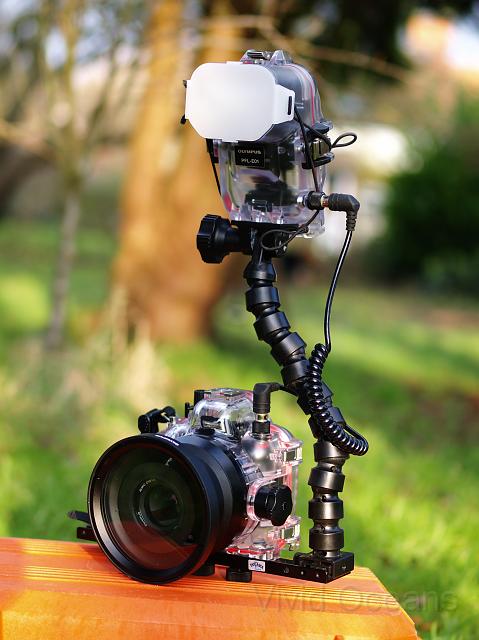
vu all over again - Olympus E-420 and modified PT-E03 Looking Flashy This review is a twin test really, not only the new camera but also a version of the OLY-TTL strobe adaptor from Matthias Heinrich which allows TTL in manual mode on E-Series SLRs. It can't do TTL in other modes because my poor old YS-60s can't recover from the rapid pre-flashes fast enough but there's no pre-flash in manual mode. The limitation of the older version meant full manual use only, but M-TTL as it's called means I can choose the shutter and aperture I want for effect, then let the camera metering manage the strobe to expose properly. It worked well, although the colour temperature of the YS60s I was trying was different from the housed Olympus FL-36 I had been using. The results were a little warmer looking - ironically that means a lower colour temperature. No problem working in RAW but a little more work than having perfect JPEGs if you don't like the results. This is because auto-white balance under flash is normally fixed and matched to a the vendors own flash. I've used these strobes for years and enjoy the look but its very easy to create a preset if you want to change it. Plastic fantastic - an open and properly shut case :-) With a day to go I had to decide if I'd go without a power switch or sort it out properly. In the end it was a simple modification with my favourite fix-it-all - Polymorph - plastic you can mould in hot water. I moulded a stepped disc by pressing Polymorph into some washers. Result: full control and no outward sign that I had a new companion in the case, 400, 410 or 420 who could tell? I thought I could, everything was just that bit better; faster and more decisive. In the PT-E03 it remains one of the few underwater SLRs you can use single handed. The E-420 doesn't really need a grip but the PT-E03 has a good one which allows the index finger to be free for the shutter while the rest grip the case well enough for your left hand to be free for other stuff... buoyancy, DSMBs, adjusting foliage or maybe steadying yourself. This is possible because the camera is small and the slight lip at the top of the grip fits most hands just so. At the same time the control dial falls nicely to thumb so shutter or aperture adjustments don't need your hand to move at all. Time
for a glass? Lens
performance is 'diffraction limited' - beyond a certain aperture
setting results soften as the iris starts to act as a light grating
rather than a simple pinhole. The point when this happens is
theoretically proportional to sensor size. As Olympus uses a smaller
sensor than other SLRs this could be a pitfall, but it doesn't seem
to be. The very thorough tests on SLRGear.com show that the Olympus
Zuiko lenses resist this as well or better than others so as well as
being sharp wide open they stay sharp until f16 just as lenses on
larger sensors should theoretically – their performance
varies. Focus
pocus Even if you're not familiar with the term 'contrast detection' you'll have used it with camcorders or compact cameras. The theory is simple, the camera looks at the picture and adjusts the lens back and forth until the details are sharp... that's why they focus faster in good light on objects with strong markings – more contrast to detect. This trick is still rare, appearing on only the biggest new Nikons for example, so as a freebie on the baby of the range it's a bonus. None of these options give true SLR focus in liveview like the E-330 had but adding the hybrid mode which enables the full AF to fine tune it makes the work round that bit better. My own preference underwater, even as an ex-compact user, is to use the optical viewfinder – steadying against your head and fast focus is a godsend - and hold the option of Liveview as a trump card for those shots where it's just not possible to have your head behind the camera or where a better overall view of the scene is required – marshalling friends with lights or strobes for example. Remotely Possible Another new feature (across the Olympus SLR range and ultrazoom compacts too) is wireless strobe control. This studio type technology is a surprise arrival at the 'bottom' of the market and it isn't just slave strobing it's a multi-channel system with full control. Three channels of numerous (I don't know if there's a limit) flashes can be controlled, the power and mode of each varied from the camera. Normally optical TTL slaving is restricted to the sync speed of the pop-up flash but here it just acts as the controller. An array of dedicated flashes can operate at shutter speeds up to 1/4000th. It adds great potential for creativity and since the optical signals can relayed by fibre it'll hit sales of flooded strobe cables too! I didn't exercise this opportunity underwater but I'm saving up to take a night shot of the Thistlegorm lit with chains of remotely controlled strobes! Results On our trips to Plymouth and Holland gave ample opportunity to test the camera and considering we didn't have tropical conditions the results were great. In these latitudes the main genre is macro and we found plenty of nudibranches to play with. They're tough to photograph as they're often very white against dark backgrounds but the spot metering kept them nicely exposed and TTL flash was able to do its job properly. The chief adjustment was of aperture to control light and depth of field as for the most part I used the top sync speed of the Sea and Sea setup of 1/250th. My strobe setup used a OLY-TTL adaptor from Matthias Heinrich which allows TTL in manual. It can't do TTL in other modes because my poor old YS-60s can't recover from the pre-flash, but there's no pre-flash in manual mode. I used it in manual all weekend - so my hard work on the dial was wasted :-) Everything else was as per the E-410. Perhaps the only thing I'd really like to change is the exposure adjustment button, which switches dial control between shutter and aperture in Manual, might work better if it toggled between the two rather than needing to be held down. At least it's ideally placed beside the shutter lever and you can choose whether you want to alter shutter or aperture without the button held down. In A or S modes, of course, it needs no 'shift' button. With the E-410 I gratefully accepted review advice to turn off noise reduction which was a little heavy handed. This is sorted for the E-420 and the only tweaks for my taste were to boost the sharpness (I like my macro shots crisp) and turn off Auto graduation. Auto graduation is one of the DR boosting functions - which opens up shadow detail – great on land but I prefer deep blacks for my macro shots. These parameters only affect JPEGs so if you shot RAW at the same time you can always change your mind. With the E-420 you can choose to shoot any size of JPEG along side losslessly compressed RAW – I do this as JPEGs are easy to handle but the RAW offers protection from inevitable mistakes :-) Interestingly Olympus have revamped their JPEG compression naming and it's now much more similar to others – named by size and quality. Large, Medium or Small plus Fine or Normal etc. The Fine JPEGs are unusually large (compared with Canon for example) with files up to 7MB – very close to the lossless RAW which are around 9MB. Conclusion: E-420 and PT-E03 (Mk2 please!) If you liked the idea of a small SLR when the E-400 was released and hankered again when the E-410 replaced it then the E-420 is the travel SLR you wanted. It does what it does really well and won't cramp your style by running out of steam when you want to upgrade or get creative. It's size maybe one of the biggest points against it, there's no boat cred in having the smallest rig and the camera was often mistaken for a compact. There's a kind of inverted snobbery in that and we enjoyed this 'stealth SLR' while others arranged much larger, heavier outfits. The PT-E03 case is as compact as it could reasonably be and works very well. The only serious criticism you could level at it is that it's nominal rating is to 'only' 40m and that a new version for the E-420 shouldn't really have been necessary with a little fore thought. Hopefully the very minor changes needed to make it work with the E-420 can be made ASAP – as they were to the PT-020 for the C-5060 to produce the PT-027 for the C-7070. The E-4xx series is still the cheapest way to take an SLR underwater and the latest is the best of the bunch, sure the case isn't ready for it yet – and may not be – but its not a tough modification and I'm sure there'll be nicely made kits before you can say 'PT-E03 Mk2 anyone?' The strongest argument against may be that its big brother, the E-520, now has the PT-E05 housing. Adding image stabilisation and more features for quite a similar price it's not grossly bigger and perhaps this is a market where some visible presence may help sales? I've yet to try a stabilised camera underwater but having used its big brother the E-3 on land I can vouch for its effectiveness there. Bonus conclusion: Matthias Heinrichs M-TTL conversion Using the Sea and Sea flashes in M-TTL made exposure pretty consistent but the YS60s need you to be in the right ball park with your other settings or you'll under or over expose, there isn't the control of a dedicated flash but their recharge speed is pretty respectable. It seems that the degree of control is less and so close After reviewing my pictures I felt the setup was under exposing by about 0.5 stop but that's erring safe and since its under camera control I can dial in more positive flash power. The adaptor is a great piece of kit but I still hanker for a true underwater flash for Olympus which can match Super FP mode and work all the way up to 1/4000th for greater exclusion of ambient light – for cooler, blacker backgrounds to macro subjects. Matthias produces myriad adaptors now for many brands of camera so there is no need to feel trapped into buying a matching strobe for any case if you want something else. More power to his elbow. When I can afford a pair of DS-125s I'll be straight online to order the interface for the E-420. Verdict More and more the results from digital SLRs are becoming so good that there's little to separate them on technical grounds and the most important factor is the way your chosen system matches your particular preferences. This set-up ticks a lot of the wish list boxes for most divers. We had interest on the boats both from divers who had considered an SLR too big and also those already using SLRs who wanted something lighter for travel. The results are excellent and affected far more by the operator than camera size – in fact much the same sensor is used on the whole Olympus range so the underlying image quality is near identical - you just get more bells and whistle with the bigger bodies. Pros: Smallest SLR, smallest case, cheapest system, great lenses and handling. Colourful, sharp, clean results. Wireless flash control promises big things Cons: 40m limit on a case which needs a mod, high speed and wireless flash need Olympus units, not big and macho SLR. E-520 (in the PT-E05) adds image stabilisation add yet more features for a similar price.
|
||||||||||||||||||
|
||||||||||||||||||
|
|
||||||||||||||||||